How to Automate Takeoffs From PDF Plans Using a Powerful PDF Takeoff API

January 28, 2026
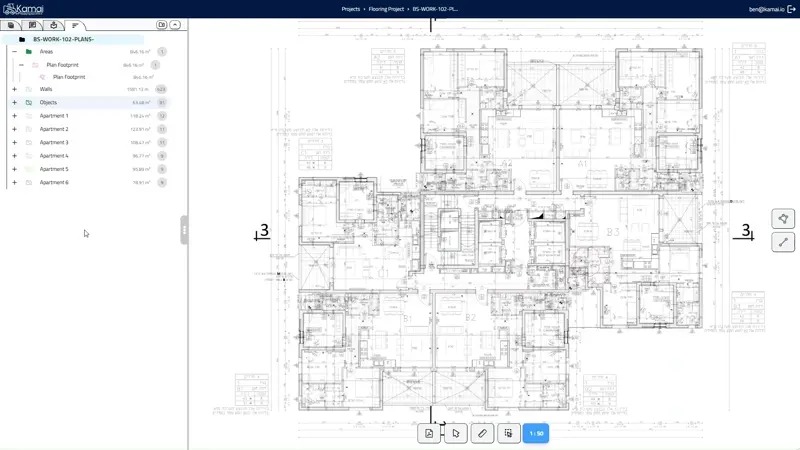
Automate takeoffs from PDF plans with Kamai’s powerful PDF takeoff API. Turn drawings into accurate quantities for faster, smarter decisions.
In construction, government infrastructure, and insurance projects, everything starts with plans. Floor plans, site layouts, elevations, and technical drawings are the foundation of cost estimates, material planning, risk assessment, and project execution. Yet for decades, one critical step has remained stubbornly manual: quantity takeoffs from PDF plans.
Despite massive advances in digital design and project management, many teams still rely on manual measurements, disconnected software, and error-prone workflows to extract quantities from drawings. The result is slow estimating, inconsistent data, costly mistakes, and delayed decisions.
This is where automation changes everything.
With a powerful PDF takeoff API like Kamai’s, organizations can automate takeoffs from PDF plans, turn complex drawings into structured data, and unlock faster, more accurate decision-making across projects. By transforming static PDFs into actionable insights, Kamai enables construction teams, government agencies, and insurance professionals to focus on strategy instead of measurements.
This article explores how automated PDF takeoffs work, why traditional methods fall short, and how Kamai’s advanced AI technology is redefining the way organizations extract quantities from floor plans and 2D drawings.
The Problem With Manual Takeoffs From PDF Plans
PDF plans are everywhere. Architects, engineers, surveyors, and planners all rely on PDFs as the standard format for sharing drawings. However, PDFs were never designed to be data-friendly. They are visual documents, not structured datasets.
Manual takeoff processes typically involve opening PDF plans in takeoff software or even basic viewers, manually scaling drawings, tracing elements, counting objects, and entering quantities into spreadsheets or estimating tools. This approach introduces several challenges.
First, manual takeoffs are slow. Even experienced estimators can spend hours or days extracting quantities from a single set of drawings. As project complexity increases, timelines stretch even further.
Second, manual processes are error-prone. A missed wall, an incorrect scale, or a simple misclick can throw off an entire estimate. Small errors compound into large cost overruns, especially in large construction or infrastructure projects.
Third, manual takeoffs don’t scale. Government agencies managing multiple projects, construction firms bidding on tight deadlines, and insurance teams assessing damages across regions cannot afford workflows that depend on individual effort.
Finally, manual takeoffs create disconnected data. Measurements live in spreadsheets, estimates live in separate tools, and insights are scattered across systems. This fragmentation limits visibility and slows decision-making.
Automating takeoffs from PDF plans addresses all of these challenges at once.
What Does It Mean to Automate Takeoffs From PDF Plans?
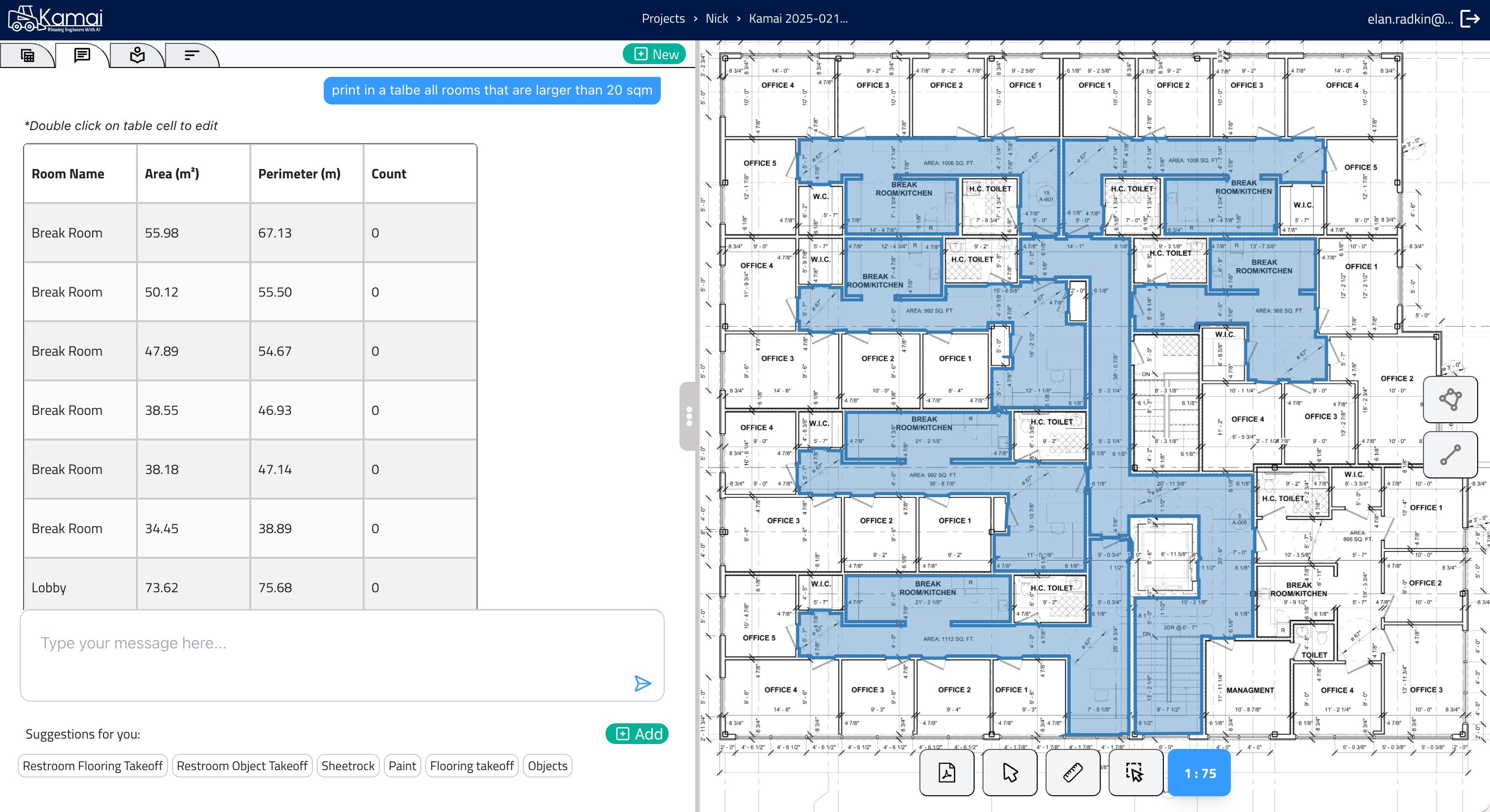
Automated takeoffs use AI and computer vision to extract quantities directly from PDF drawings without manual tracing or counting. Instead of measuring line by line, software analyzes the drawing, identifies objects, understands scale, and converts visual elements into structured data.
A PDF takeoff API enables this process programmatically. Rather than relying on standalone tools, organizations can integrate automated takeoff capabilities directly into their existing platforms, estimating software, or internal systems.
With automation, PDF plans become data sources rather than static documents. Walls, rooms, areas, lengths, and counts are extracted consistently and accurately, allowing teams to move from drawings to decisions faster than ever before.
How a PDF Takeoff API Works
A modern PDF takeoff API like Kamai’s uses advanced AI models trained on construction and engineering drawings. These models understand how plans are structured, how symbols represent real-world elements, and how scale and dimensions work across different drawing styles.
The process typically follows several key steps.
First, the PDF plan is uploaded or passed into the API. This can happen automatically as part of a workflow, such as when a new plan is added to a project folder or uploaded to an estimating platform.
Next, the AI analyzes the drawing. It identifies layers, symbols, lines, text, and shapes, distinguishing between different elements such as walls, doors, rooms, and fixtures. This step goes far beyond simple image recognition; it understands construction context.
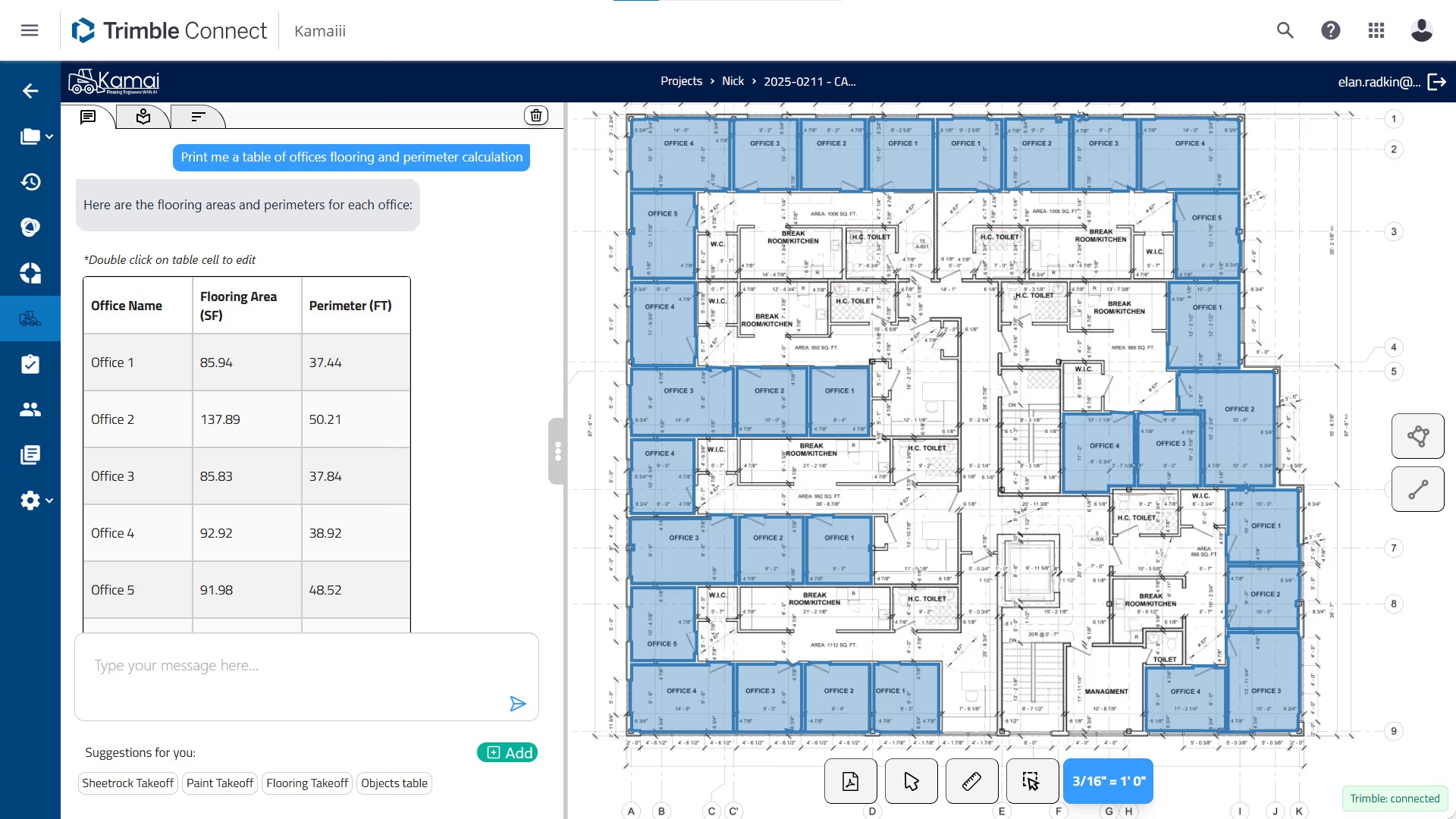
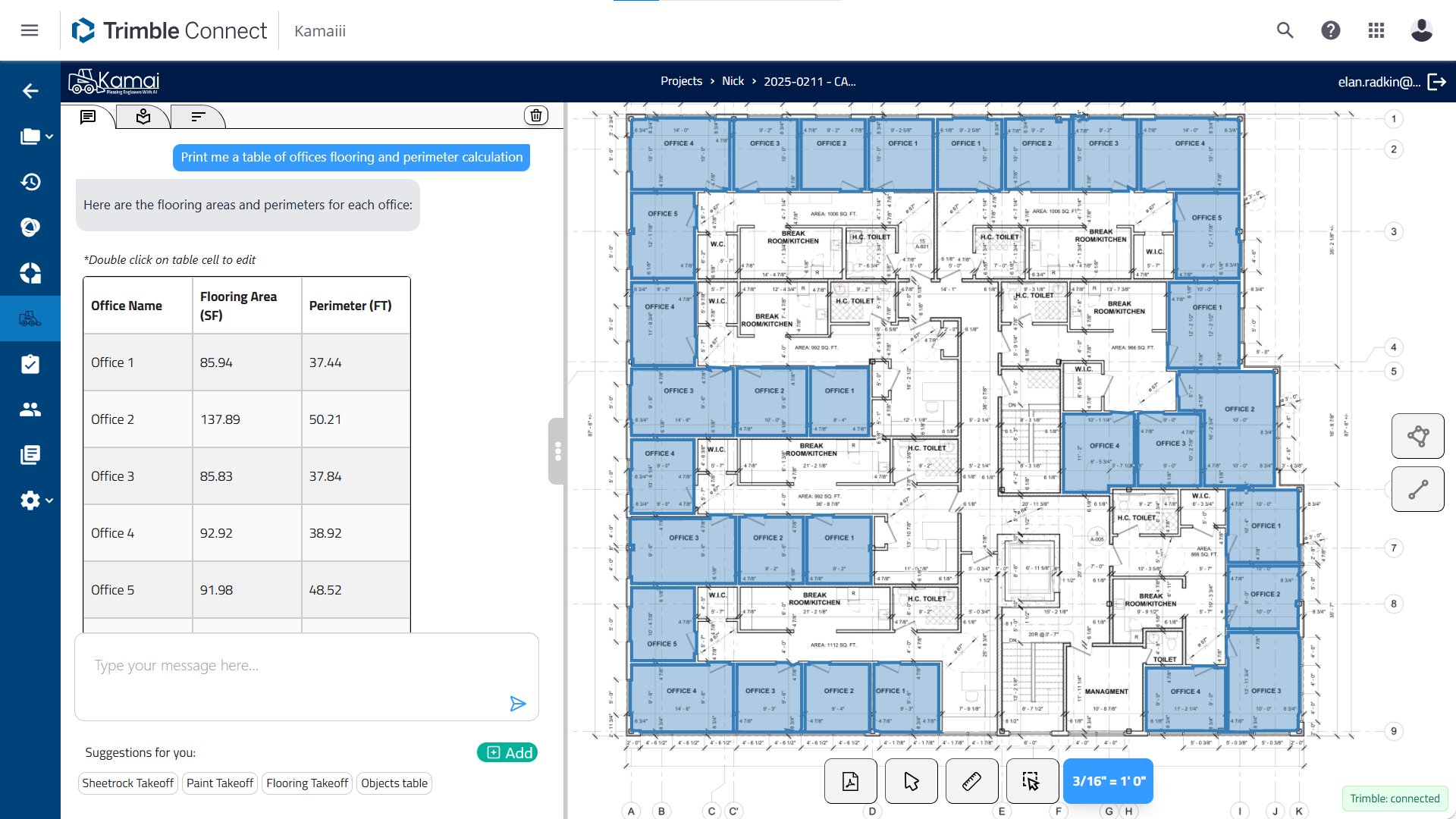
Then, quantities are extracted. Lengths, areas, counts, and measurements are calculated based on scale and drawing information. The result is structured data that reflects real-world quantities.
Finally, the data is returned via the API in a format that can be consumed by other systems. This might include JSON outputs, integrations with estimating software, or direct population of databases.
Kamai’s PDF takeoff API is designed to deliver highly accurate results at speed, enabling teams to trust the data and act on it immediately.
Turning PDFs Into Quantities With Accuracy and Confidence
Accuracy is the most important factor in any takeoff process. Inaccurate quantities lead to flawed estimates, budget overruns, and delayed projects. This is especially critical for government and insurance organizations, where decisions often carry regulatory, financial, and public safety implications.
Kamai provides highly accurate data by combining AI precision with construction-specific intelligence. The system is trained to handle real-world plans, including variations in drawing styles, scales, and levels of detail.
Unlike basic OCR or generic image processing tools, Kamai’s technology is purpose-built for the built environment. It understands floor plans, elevations, and technical drawings the way an experienced estimator would, but with machine-level consistency.
This level of accuracy allows customers to make timely, informed, and better decisions, whether they are planning infrastructure projects, estimating construction costs, or assessing insurance claims.
Faster Estimating From Drawings at Scale
One of the most immediate benefits of automating takeoffs from PDF plans is speed. What once took hours can now take minutes.
For construction teams, this means responding to bids faster and with greater confidence. Estimators can focus on reviewing results and refining assumptions instead of manually measuring every element.
For government agencies, automation enables consistent analysis across multiple projects, regions, or contractors. Standardized data extraction ensures fairness, transparency, and efficiency in planning and procurement.
For insurance organizations, faster takeoffs support quicker damage assessments and claims processing. When quantities can be extracted automatically from plans or drawings, adjusters and analysts can move from documentation to decision much faster.
By eliminating manual bottlenecks, Kamai’s PDF takeoff API enables organizations to scale their operations without increasing headcount.
Structured Data From 2D Plans Unlocks New Insights
PDF plans traditionally trap valuable information in unstructured formats. Once quantities are extracted manually, they often remain isolated in spreadsheets or PDFs, limiting their usefulness beyond a single estimate.
Automated takeoffs change this by producing structured data from 2D plans. This structured data can be stored, analyzed, compared, and reused across projects.
With structured takeoff data, organizations can track trends, benchmark costs, and identify risks earlier. Construction firms can analyze historical quantities to improve future estimates. Government agencies can compare infrastructure needs across regions. Insurance teams can standardize assessments and reduce variability.
Kamai’s technology turns drawings into a reliable data foundation that supports long-term intelligence, not just one-off measurements.
Integrating Takeoff Into Estimating Software and Platforms
One of the biggest advantages of using a PDF takeoff API is flexibility. Instead of forcing teams to adopt new standalone tools, APIs allow takeoff automation to be embedded directly into existing workflows.
Kamai enables organizations to integrate takeoff into estimating software, project management platforms, or internal systems. This might take the form of an embedded takeoff widget, an in-app takeoff module, or a plan takeoff plugin that works seamlessly inside a familiar interface.
For software providers, this means adding powerful takeoff functionality without building it from scratch. For enterprises, it means minimizing disruption while modernizing workflows.
By planning takeoffs inside your platform, users never have to switch tools or export files manually. Data flows automatically from drawings to estimates, reports, and dashboards.
Your AI Co-Pilot on Every Project
Automation alone isn’t enough. Teams also need clarity and confidence in the data they receive. This is where Kamai’s built-in AI assistant plays a critical role.
Kamai’s AI co-pilot allows users to ask questions, verify quantities, and gain instant insights from extracted data. It works like an expert estimator by your side, always available and always consistent.
Users can query takeoff results, validate assumptions, and explore alternative scenarios without digging through raw data. This interactive layer transforms automated takeoffs into a collaborative decision-making tool.
For complex projects, having an AI assistant that understands both the drawings and the data ensures that teams stay aligned and informed at every stage.
Use Cases Across Construction, Government, and Insurance
Kamai’s PDF takeoff API is designed to support a wide range of use cases.
In construction, it accelerates preconstruction workflows, improves bid accuracy, and supports better project planning. Contractors and developers can automate takeoffs across residential, commercial, and infrastructure projects.
In government, automated takeoffs support infrastructure planning, procurement, compliance, and asset management. Agencies benefit from standardized, auditable data that improves transparency and efficiency.
In insurance, takeoff automation supports faster claims assessment, damage estimation, and risk evaluation. Structured quantities help insurers make fair, timely decisions while reducing operational overhead.
Across all sectors, the common thread is better data delivered faster.
Why Kamai Stands Out
Not all PDF takeoff solutions are created equal. Kamai differentiates itself through accuracy, scalability, and ease of integration.
Its AI models are trained specifically for real-world plans and drawings, not generic images. Its API-first approach makes it easy to embed takeoff capabilities into any platform. And its focus on structured data ensures long-term value beyond individual projects.
Most importantly, Kamai enables customers to move from blueprint chaos to clarity. By transforming complex drawings into actionable insights, it empowers organizations to make smarter decisions with confidence.
The Future of Automated Takeoffs
As projects grow more complex and timelines become tighter, manual takeoffs will continue to fall behind. Automation is no longer a nice-to-have; it is becoming a competitive necessity.
PDF takeoff APIs represent the next evolution in estimating and planning. They bridge the gap between visual documents and data-driven decision-making.
With Kamai, organizations can automate takeoffs from PDF plans, turn PDFs into quantities, and unlock the full value of their drawings. The result is faster workflows, higher accuracy, and better outcomes across construction, government, and insurance.
Conclusion
Automating takeoffs from PDF plans using a powerful PDF takeoff API is one of the most impactful upgrades an organization can make. It replaces slow, error-prone manual processes with fast, accurate, and scalable data extraction.
Kamai provides highly accurate data that enables customers in construction, government, and insurance to make timely, informed, and better decisions. By transforming 2D plans into structured data and actionable insights, Kamai acts as your AI co-pilot on every project.
In an industry built on drawings, the ability to turn plans into intelligence is no longer optional. With Kamai, it’s automatic.