Extract Reliable Quantities From Floor Plans for Government and Infrastructure Projects

February 3, 2026
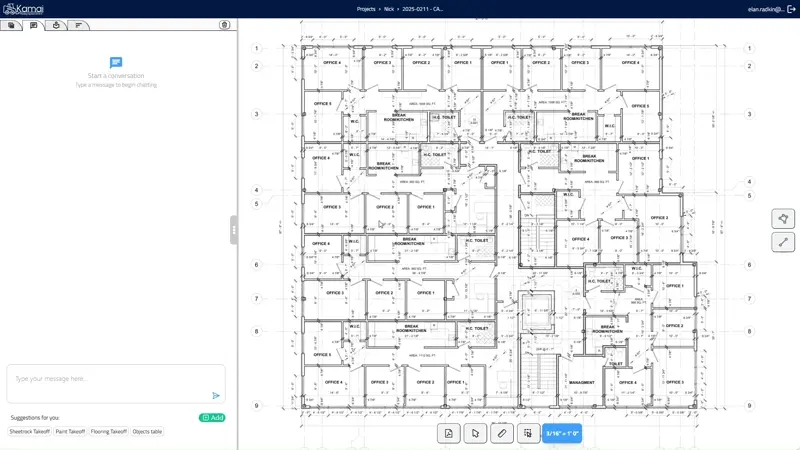
Extract reliable quantities from floor plans with Kamai’s AI powered takeoff. Turn blueprint chaos into structured data for faster, informed government decisions.
Government and infrastructure projects are built on plans, but governed by accountability. Every floor plan, site layout and technical drawing represents public investment, long-term impact and regulatory responsibility. When quantities are inaccurate or inconsistent, the consequences go far beyond cost overruns they affect public trust, safety and delivery timelines.
Yet despite the critical nature of these projects, many government agencies and infrastructure authorities still rely on manual, fragmented processes to extract quantities from floor plans. Static PDFs, disconnected tools and human-dependent workflows introduce delays, inconsistencies and risk.
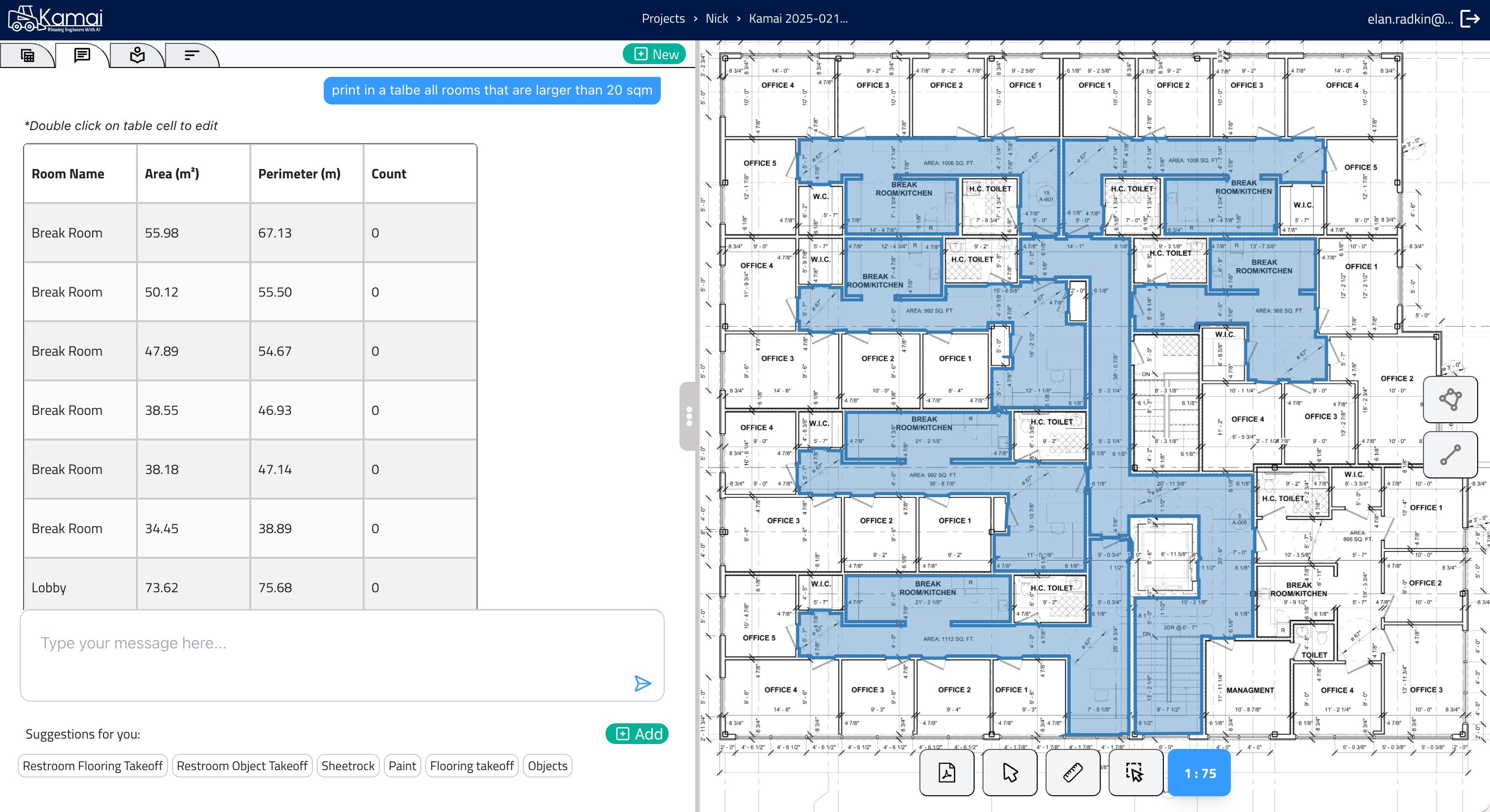
Kamai addresses this challenge by turning construction blueprint chaos into structured data. By extracting data from blueprints with enhanced speed and accuracy, Kamai provides highly accurate quantities that enable customers in government, construction and insurance to make timely, informed and better decisions.
This article explores why reliable quantity extraction matters in public-sector projects, the limitations of traditional workflows and how Kamai’s AI-powered technology transforms floor plans into trusted, decision-ready data.
Why Quantity Accuracy Is Critical in Government and Infrastructure Projects
Unlike private construction, government and infrastructure projects operate under heightened scrutiny. Budgets are fixed, timelines are public and decisions must withstand audits, reviews and political oversight.
Accurate quantities are essential at every stage. During planning, they determine feasibility and funding allocations. During procurement, they influence tender pricing and contractor selection. During execution, they guide material sourcing, scheduling and progress tracking.
Even small errors in quantity takeoffs can have large consequences. Overestimated quantities can waste public funds. Underestimated quantities can lead to change orders, delays and disputes. Inconsistent data across projects undermines standardization and long-term planning.
For government agencies, reliability is not optional. Quantity data must be accurate, repeatable and defensible.
The Challenge of Extracting Quantities From Floor Plans
Floor plans are one of the most information-dense components of infrastructure documentation. They define spatial layouts, dimensions and relationships that directly impact scope and cost.
However, floor plans are typically delivered as 2D PDFs, designed for human interpretation rather than automated analysis. Extracting quantities from these documents often requires manual measurement, visual interpretation and data entry.
This process creates several challenges.
First, it is slow. Large infrastructure projects may involve hundreds of drawings, each requiring careful review.
Second, it is inconsistent. Different estimators may interpret the same plan differently, leading to variation in quantities.
Third, it is difficult to audit. Manual takeoffs leave limited traceability, making it harder to justify decisions during reviews or disputes.
These challenges make traditional takeoff workflows poorly suited for modern public-sector requirements.
Turning Construction Blueprint Chaos Into Structured Data
Blueprint chaos isn’t about poor documentation. It’s about information trapped in formats that don’t align with digital decision-making.
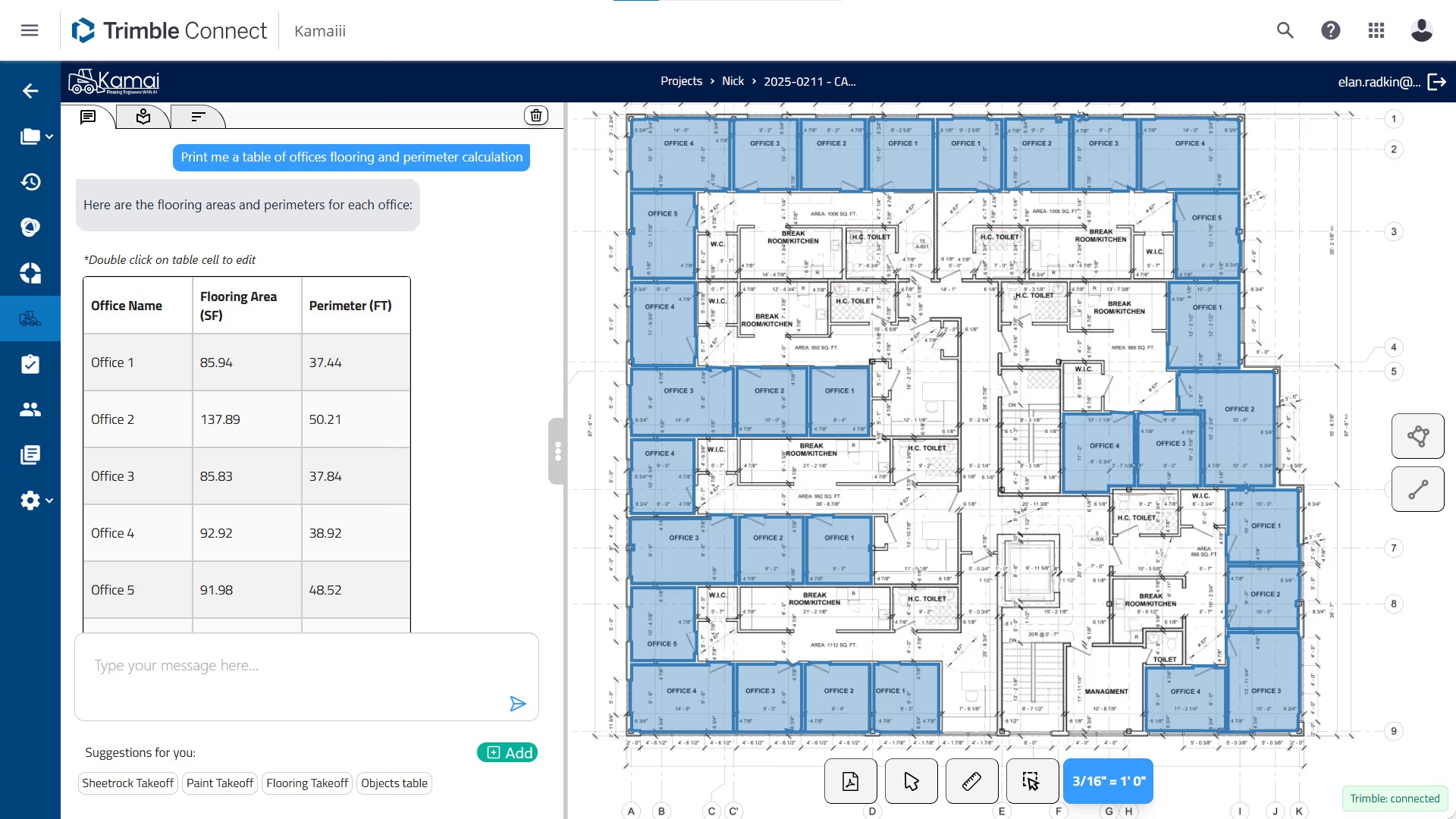
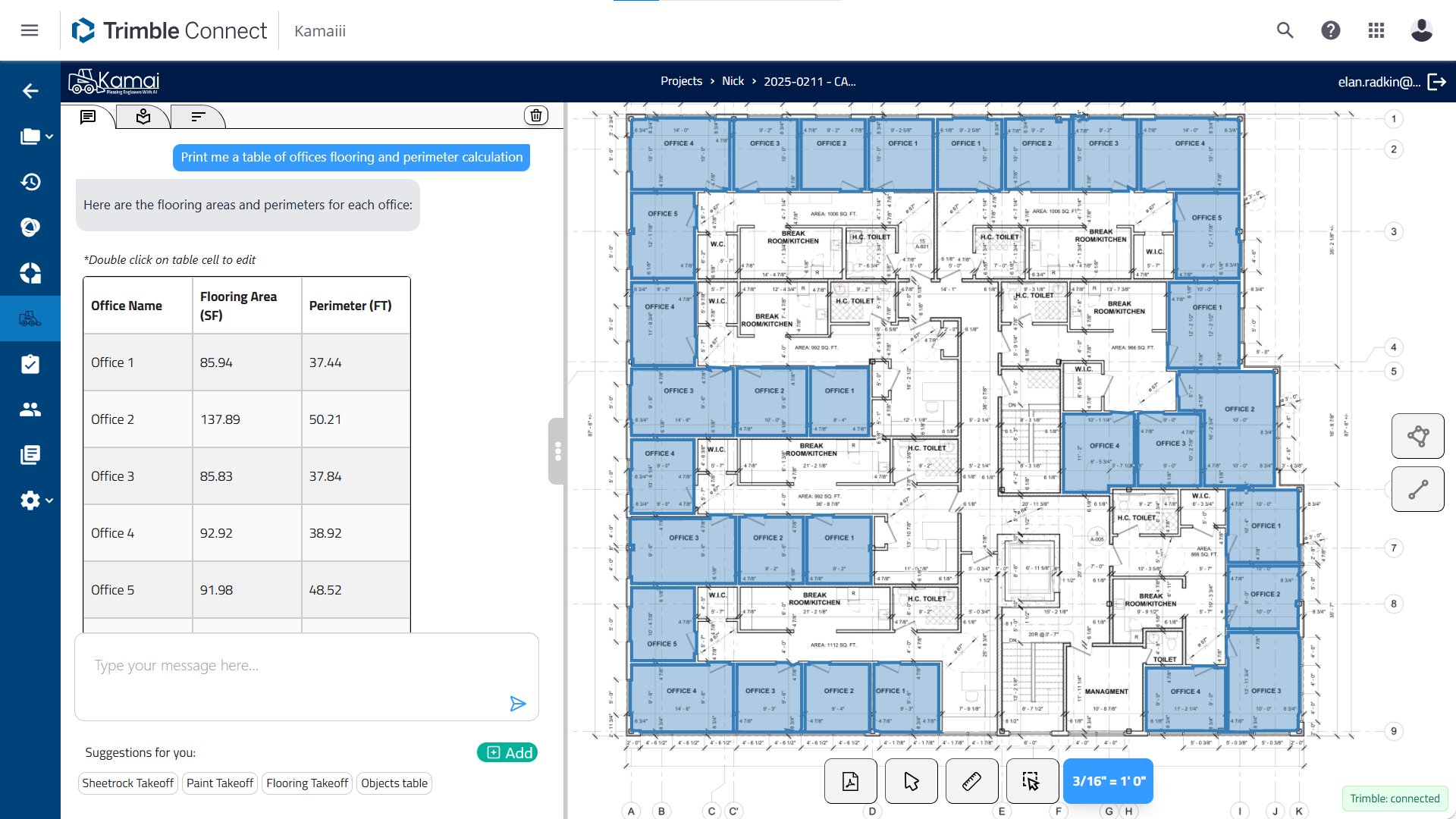
Kamai solves this by transforming unstructured blueprints into structured data. Instead of treating floor plans as images, Kamai’s AI understands them as representations of real-world elements with measurable properties.
Walls become lengths. Spaces become areas. Components become countable objects. This transformation turns visual complexity into organized, machine-readable data that can be used consistently across systems.
Structured data enables faster analysis, easier validation and better long-term planning especially in large-scale infrastructure programs.
How Kamai Extracts Reliable Quantities With Enhanced Speed and Accuracy
Kamai’s Takeoff API is built on advanced AI models trained specifically on construction and infrastructure drawings. These models understand architectural conventions, symbols and spatial relationships common in public-sector projects.
When a floor plan is processed, Kamai analyzes the drawing contextually. It identifies elements, applies scale accurately and calculates quantities automatically. The result is a set of reliable, structured quantities extracted with enhanced speed and accuracy.
Unlike manual workflows, this process is consistent and repeatable. Every plan is analyzed using the same logic, reducing variability and improving trust in the results.
This level of reliability is essential for government agencies that must standardize processes across departments, regions and contractors.
Supporting Timely and Informed Public-Sector Decisions
Government decisions often operate under tight timelines. Budget cycles, procurement windows and emergency infrastructure needs leave little room for delay.
By automating quantity extraction, Kamai enables faster access to reliable data. Decision-makers no longer need to wait for manual takeoffs to be completed before evaluating options.
With accurate quantities available early, agencies can assess feasibility, compare alternatives and allocate resources more effectively. This supports proactive planning rather than reactive problem-solving.
Kamai’s highly accurate data empowers public-sector leaders to make informed decisions with confidence.
Standardization Across Projects and Agencies
One of the biggest challenges in government infrastructure is standardization. Different teams, consultants and contractors often use different tools and methodologies, resulting in inconsistent data.
Kamai addresses this by providing a unified approach to quantity extraction. By applying the same AI-driven logic to every floor plan, Kamai ensures consistency across projects, regardless of who created the drawings.
This standardization simplifies comparisons, supports benchmarking and enables centralized oversight. It also reduces dependency on individual expertise, making workflows more resilient over time.
For large infrastructure portfolios, this consistency is a major operational advantage.
Seamless Integration Into Government and Enterprise Systems
Government organizations rely on established platforms for planning, procurement and asset management. Any new technology must integrate smoothly into these environments.
Kamai is designed with integration in mind. Its API-first architecture allows quantity extraction to be embedded directly into existing systems, dashboards and workflows.
This means agencies can plan takeoffs inside their approved platforms without introducing new standalone tools. Data flows automatically from floor plans into estimates, reports and analytics systems.
Seamless integration reduces friction, accelerates adoption and ensures compliance with internal IT and security standards.
Transparency, Auditability, and Trust
Public-sector projects demand transparency. Every decision must be explainable and defensible.
By producing structured, traceable data, Kamai improves auditability. Quantities can be reviewed, validated and compared across revisions, providing a clear data trail.
This transparency builds trust with stakeholders, auditors and the public. It also reduces the risk of disputes by ensuring that estimates are based on consistent, verifiable data.
Kamai’s approach aligns with the governance requirements of public infrastructure projects.
Use Cases Across Government, Construction and Insurance
While this article focuses on government and infrastructure, Kamai’s technology delivers value across related sectors.
In construction, automated quantity extraction accelerates preconstruction workflows and improves bid accuracy.
In insurance, it supports faster damage assessment and cost evaluation by extracting quantities from plans and drawings.
Across all sectors, Kamai provides highly accurate data that enables better decisions under pressure.
Reducing Risk in Large Scale Infrastructure Programs
Risk management is a core concern in infrastructure projects. Inaccurate quantities introduce uncertainty that can ripple through budgets, schedules and contracts.
By extracting reliable quantities early, Kamai helps reduce risk before it becomes costly. Decision-makers can identify scope changes, assess impacts and adjust plans proactively.
This shift from reactive correction to proactive control improves outcomes and protects public investment.
The Future of Quantity Extraction in Public Infrastructure
As infrastructure projects become larger and more complex, manual workflows will continue to fall short. Governments are increasingly seeking digital solutions that improve efficiency, transparency and accountability.
AI-powered quantity extraction represents a foundational capability for modern infrastructure management. By connecting drawings directly to data, agencies can move toward more predictive, data-driven planning.
Kamai is positioned at the center of this transformation, helping public-sector organizations unlock the full value of their floor plans and blueprints.
Conclusion
Extracting reliable quantities from floor plans is essential for the success of government and infrastructure projects. Manual processes are slow, inconsistent and difficult to scale, creating risk in environments where accuracy and accountability matter most.
Kamai turns construction blueprint chaos into structured data by extracting quantities from blueprints with enhanced speed and accuracy. The result is highly accurate data that enables customers in government, construction and insurance to make timely, informed and better decisions.
For public-sector organizations seeking clarity, consistency and confidence, Kamai delivers a smarter way to move from plans to decisions.