What are Extract Quantities From Floor Plans?

kamai.io
May 21, 2026
6 Min
Learn what extracting quantities from floor plans means in construction estimating and how Kamai automates quantity takeoffs from PDF drawings with AI-powered blueprint analysis for faster, more accurate estimates.
In construction estimating, one of the most important steps before pricing a project is extracting quantities from floor plans. This process transforms architectural drawings, PDF blueprints, and construction plans into measurable data that estimators, contractors, and project managers can use to calculate costs, materials, labor, and timelines.
In simple terms, extracting quantities from floor plans means identifying and measuring everything required to complete a construction project.
It answers one of the most important questions in construction:
“How much work is actually involved?”
Without accurate quantities, construction estimates become unreliable. Material orders may be incorrect, labor costs can be underestimated, and project budgets may quickly fall apart. That is why quantity extraction remains one of the foundations of successful construction planning and estimating.
Today, AI-powered solutions like Kamai are transforming how construction teams extract quantities from drawings. Instead of relying on rulers, manual calculations, and spreadsheets, contractors can now automate the process using intelligent blueprint analysis technology.
Understanding Quantity Extraction in Construction
Construction drawings contain enormous amounts of information. Every wall, room, opening, fixture, and system shown on a floor plan represents measurable work.
Extracting quantities means identifying those elements and converting them into usable construction data.
Depending on the trade and project type, this can include measuring:
- Flooring areas
- Wall lengths
- Ceiling areas
- Roof dimensions
- Concrete volumes
- Excavation quantities
- Pipe lengths
- Cable runs
- Door and window counts
- Lighting fixtures
- Paintable surfaces
- Room perimeters
Every construction discipline relies on different quantities, but the objective remains the same: turning drawings into measurable scope.
For estimators, these quantities become the foundation for pricing materials, calculating labor, planning procurement, and building competitive bids.
Why Extracting Quantities from Floor Plans Matters
Accurate quantities directly affect project profitability.
If quantities are wrong, the estimate is wrong.
A small measurement mistake on a drawing may seem insignificant initially, but across large construction projects, even minor errors can create major financial consequences.
Incorrect quantities often lead to:
- Material shortages
- Budget overruns
- Delayed schedules
- Excess waste
- Rework
- Underpriced bids
- Scope gaps
Reliable quantity extraction helps contractors work more confidently and consistently throughout the project lifecycle.
When construction teams extract accurate quantities from floor plans, they can:
- Create more precise estimates
- Order the correct amount of materials
- Reduce waste and overordering
- Compare drawing revisions more easily
- Improve project planning
- Increase bidding confidence
- Reduce manual calculation errors
This is why quantity takeoffs remain one of the most important parts of preconstruction.
Traditional Manual Quantity Takeoffs
Before digital takeoff software became common, quantity extraction was entirely manual.
Estimators worked from printed plans using:
- Scale rulers
- Colored pens and highlighters
- Calculators
- Manual spreadsheets
- Handwritten notes
The process was extremely time-consuming.
An estimator would physically measure walls, count fixtures, calculate areas manually, and organize the data into spreadsheets for pricing. Every drawing revision often required repeating much of the work from the beginning.
While experienced estimators developed strong workflows over time, manual quantity takeoffs still created several major challenges.
Human Error: Manual measurements can lead to missed areas, duplicated counts, incorrect scales, or simple calculation mistakes.
Slow Estimating Processes: Large commercial projects often require hundreds of measurements across multiple drawing sheets. Manual workflows significantly slow bid preparation.
Difficult Revision Management: Construction drawings frequently change. Updating quantities manually across revised plans creates additional risk and wasted time.
Limited Scalability: As contractors pursue more projects, manual estimating processes become difficult to scale without adding more estimating staff.
These challenges are one reason why the construction industry has increasingly shifted toward digital and AI-powered takeoff technology.
Digital Quantity Extraction from Floor Plans
Modern construction teams now use digital takeoff solutions to extract quantities directly from PDF drawings and digital plans.
Instead of relying on printed documents, estimators can work directly on-screen using automated measurement tools.
Digital quantity extraction improves:
- Speed
- Accuracy
- Collaboration
- Revision tracking
- Workflow efficiency
However, not all takeoff solutions are equally advanced.
Basic digital takeoff software still requires estimators to manually click, trace, and count objects themselves. While this is faster than paper workflows, it still consumes significant time on large projects.
AI-powered platforms like Kamai take automation much further.
How Kamai Automates Quantity Extraction from Floor Plans
Kamai is designed to transform construction blueprint chaos into structured construction data automatically.
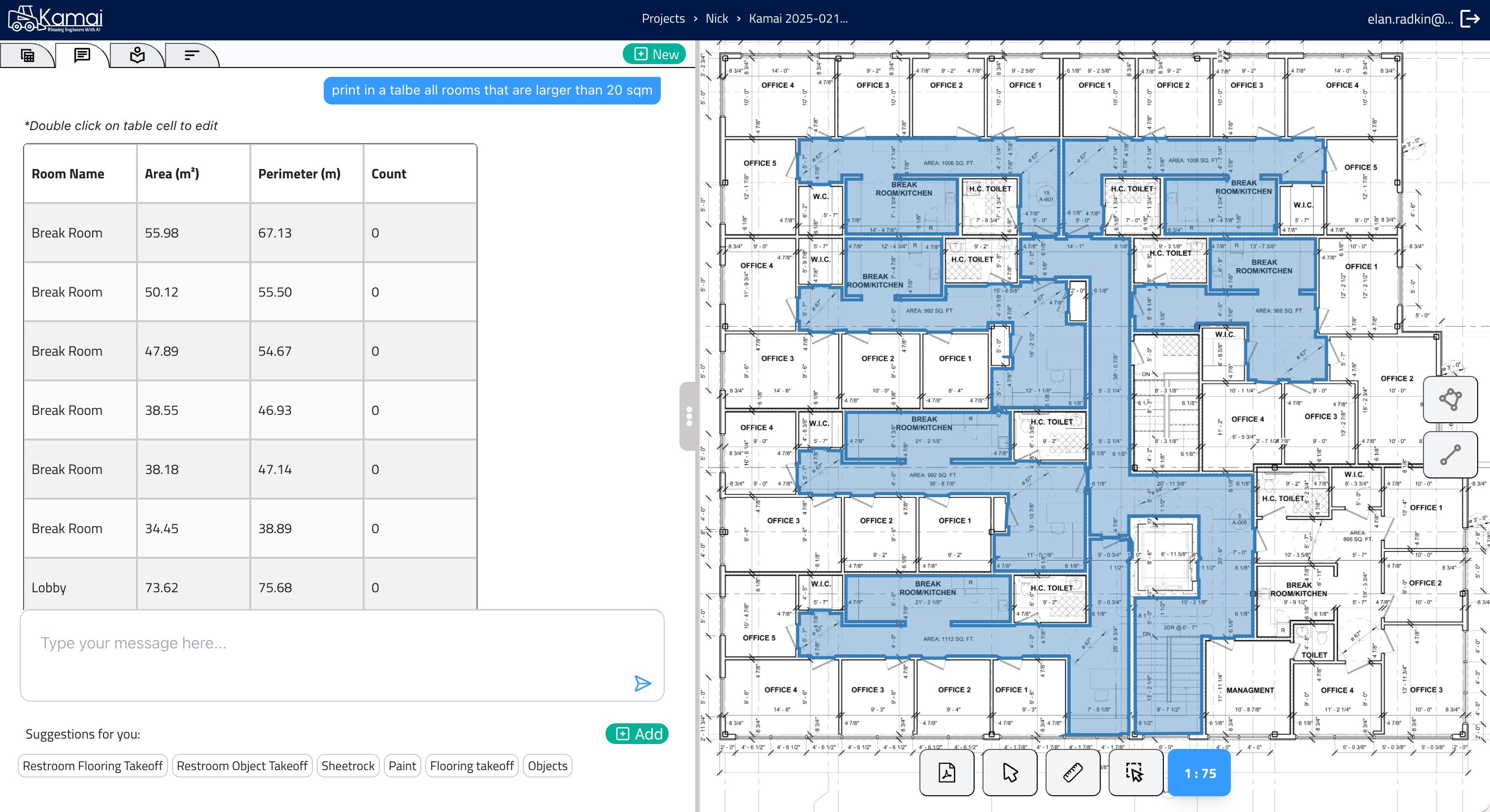
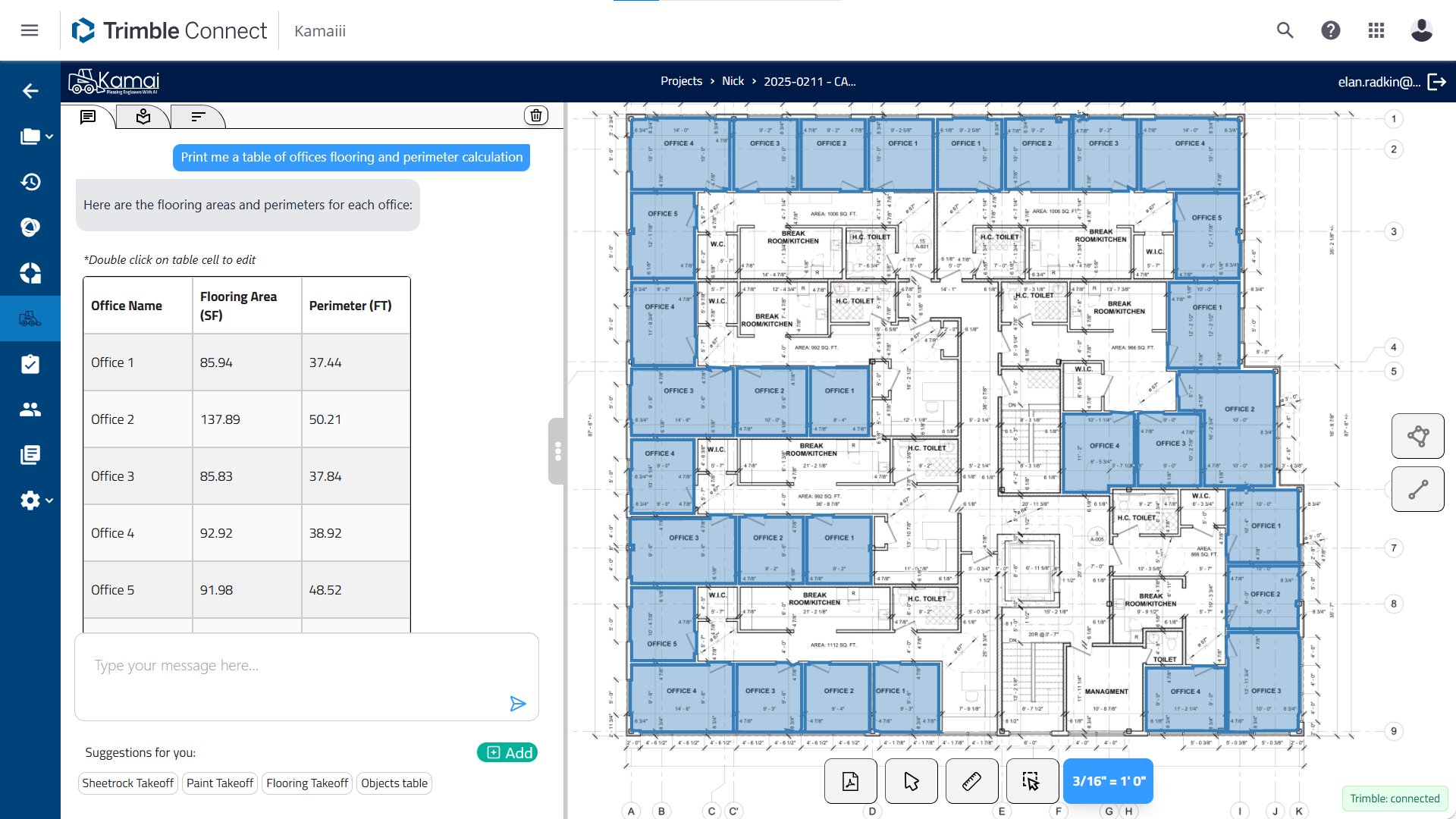
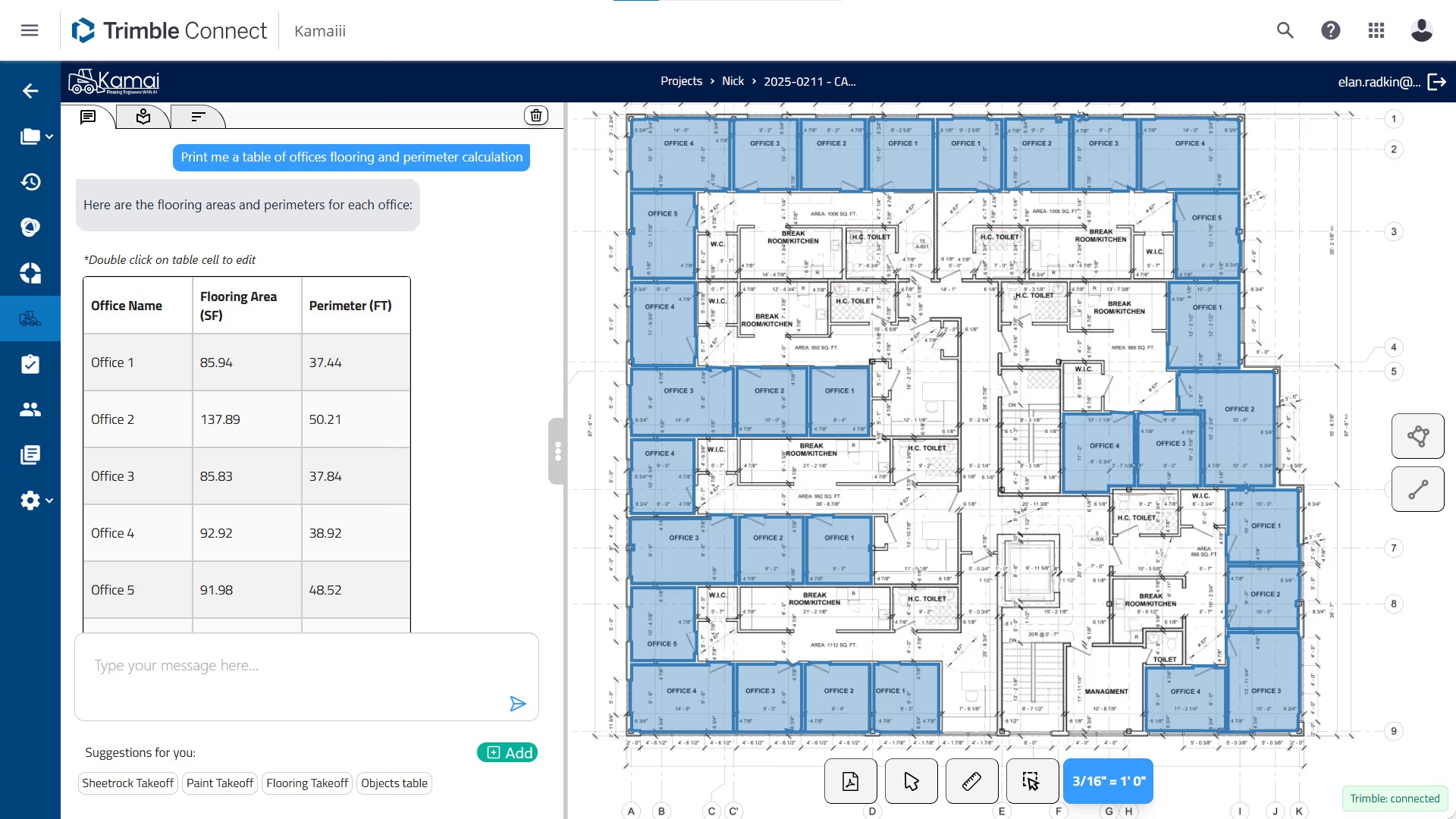
Instead of manually measuring every room, wall, or fixture, users simply upload their floor plans and let Kamai perform the heavy lifting.
Using advanced AI and computer vision technology, Kamai can instantly analyze PDF drawings and identify measurable construction elements with remarkable speed and accuracy.
The system automatically detects:
- Areas and room dimensions
- Volumes and material quantities
- Wall lengths and perimeters
- Fixtures and objects
- Architectural components
- MEP systems and symbols
This dramatically reduces manual estimating effort while improving consistency across projects.
Rather than spending hours reviewing drawings line by line, estimators can receive structured quantity data in minutes.
Turning Floor Plans into Actionable Construction Data
One of the biggest advantages of AI-powered quantity extraction is that the information becomes immediately usable.
Kamai does not simply generate measurements. It transforms raw blueprint information into structured construction intelligence.

This helps teams move directly from drawings to estimating, planning, and decision-making.
Contractors can use extracted quantities to:
- Build accurate estimates
- Forecast material costs
- Plan procurement schedules
- Compare project revisions
- Analyze project scope
- Improve bid preparation
- Reduce estimating bottlenecks
By automating repetitive measurement tasks, estimators can spend more time focusing on pricing strategy, project evaluation, and risk analysis.
Why AI-Powered Quantity Extraction Is Becoming Essential
Construction projects are becoming more complex while bid timelines continue to shrink.
Estimating teams are under constant pressure to complete more bids faster without sacrificing accuracy.
AI-powered quantity extraction helps solve this challenge by removing much of the repetitive manual work traditionally required during takeoffs.
Kamai allows contractors to:
- Skip manual measurements
- Analyze floor plans instantly
- Improve bid turnaround time
- Increase estimate consistency
- Reduce human error
- Handle revisions faster
- Scale estimating workflows more efficiently
This creates a major competitive advantage for contractors looking to improve productivity without significantly expanding estimating teams.
The Future of Quantity Takeoffs
The construction industry is moving toward smarter and more automated workflows.
While traditional 2D floor plans and PDF drawings remain essential across the industry, the way teams interact with those documents is rapidly changing.
Instead of treating drawings as static documents that require manual interpretation, platforms like Kamai convert them into intelligent datasets that can support estimating, planning, procurement, and project execution.
This shift is transforming how construction teams manage preconstruction workflows.
AI-powered quantity extraction is no longer simply a convenience. It is becoming a critical tool for contractors who want to improve efficiency, accuracy, and profitability in an increasingly competitive market.