How Takeoff API Transforms 2D Plans into Structured Construction Insights

April 10, 2026

Discover how Kamai’s Takeoff API transforms 2D plans into structured construction insights, enabling faster estimating, accurate takeoffs, and smarter decisions.
In today’s construction environment, data is everything. Yet, much of the industry still relies on static 2D drawings PDF plans, scanned blueprints, and tender documents that were never designed to be easily analyzed or integrated into modern workflows. These documents contain critical project information, but extracting it manually is slow, error-prone, and inefficient.
This is where Kamai’s Takeoff API changes everything. By transforming 2D plans into structured construction insights, Kamai enables teams to move from manual interpretation to automated intelligence unlocking speed, accuracy, and scalability across the entire estimating process.
The Problem with Traditional 2D Plans
Despite the rise of digital construction tools, 2D drawings remain the backbone of most projects. Contractors, estimators, and project managers still depend on them during bidding, planning, and execution.
However, these plans create a major challenge: valuable data is locked inside visual elements like lines, symbols, and annotations. To extract this information, teams must manually measure dimensions, count items, and calculate quantities. This process is not only time-consuming but also introduces risks such as:
- Missed measurements
- Incorrect calculations
- Inconsistent data across teams
- Delays in bidding and decision-making
For large or complex projects, these inefficiencies multiply quickly, limiting productivity and profitability.
What Is a Takeoff API?
A Takeoff API is a powerful interface that allows software platforms to automatically extract quantities and measurements directly from digital construction drawings. Instead of manually reviewing plans, teams can upload files and instantly receive structured data such as:
- Areas and volumes
- Material quantities
- Counts of fixtures and components
- Linear measurements
Kamai’s Takeoff API takes this concept further by using advanced AI and computer vision to interpret drawings with high precision, converting raw visual data into actionable insights.
Turning 2D Drawings into Structured Data
One of the biggest advantages of Kamai is its ability to convert unstructured blueprint data into organized, structured outputs that can be used across multiple workflows.
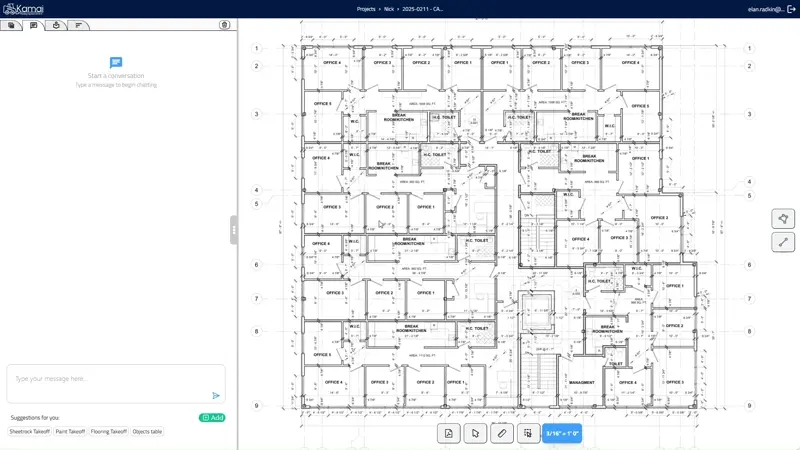
When a user uploads a plan set, the system automatically analyzes the drawings to identify key elements such as walls, rooms, openings, and MEP components. Instead of simply reading text, Kamai understands patterns, relationships, and geometry within the drawings.
This means the platform doesn’t just extract numbers it builds a structured representation of the project. Rooms can be categorized, materials quantified, and layouts interpreted in a way that supports real decision-making.
The result is a clean dataset that can be exported, integrated, or queried without additional manual effort.
Automating Quantity Takeoffs at Scale
Traditional takeoffs often require hours or even days to complete, especially when dealing with multi-sheet drawing sets. Kamai’s Takeoff API automates this entire process.
Once drawings are uploaded, the system processes them almost instantly, generating detailed quantity takeoffs across architectural and MEP elements. Flooring areas, wall surfaces, pipe lengths, fixture counts, and more are calculated with precision.
This automation allows construction teams to:
- Complete takeoffs in minutes instead of days
- Reduce human error significantly
- Handle multiple projects simultaneously
- Increase bid volume without expanding teams
For growing companies, this scalability is a game-changer.
Multi-Sheet Intelligence for Complex Projects
Construction projects rarely consist of a single drawing. Most involve dozens or even hundreds of sheets across different disciplines and levels.
Kamai’s Takeoff API is designed to handle full plan sets, not just individual files. It recognizes relationships across multiple sheets, ensuring consistency and continuity throughout the project.
This means estimators no longer need to manually combine data from separate drawings. Instead, the system provides a unified view of quantities across all plans, enabling faster and more reliable project analysis.
From Documents to Queryable Data
One of the most powerful transformations enabled by Kamai is the shift from static documents to interactive data.
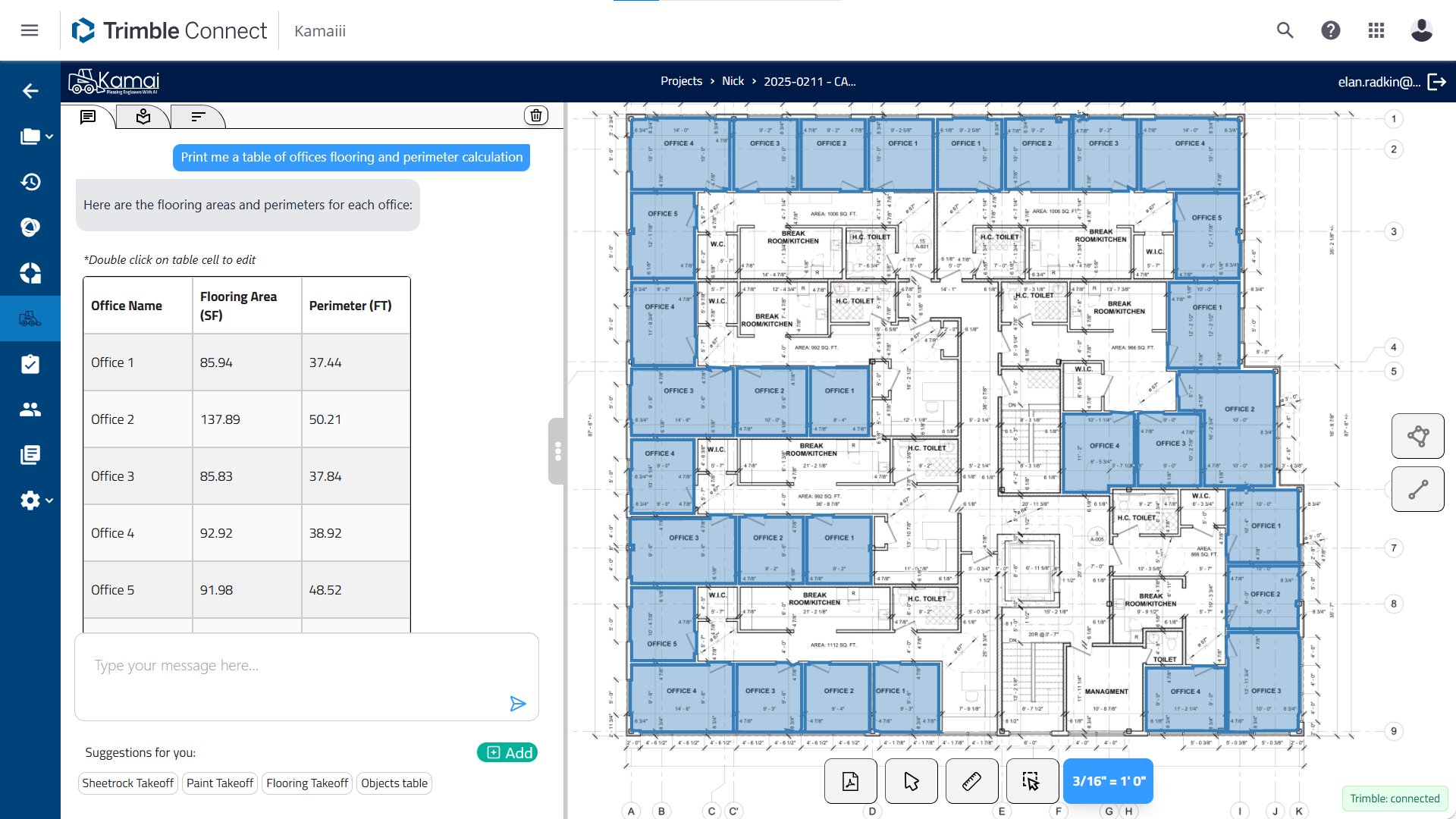
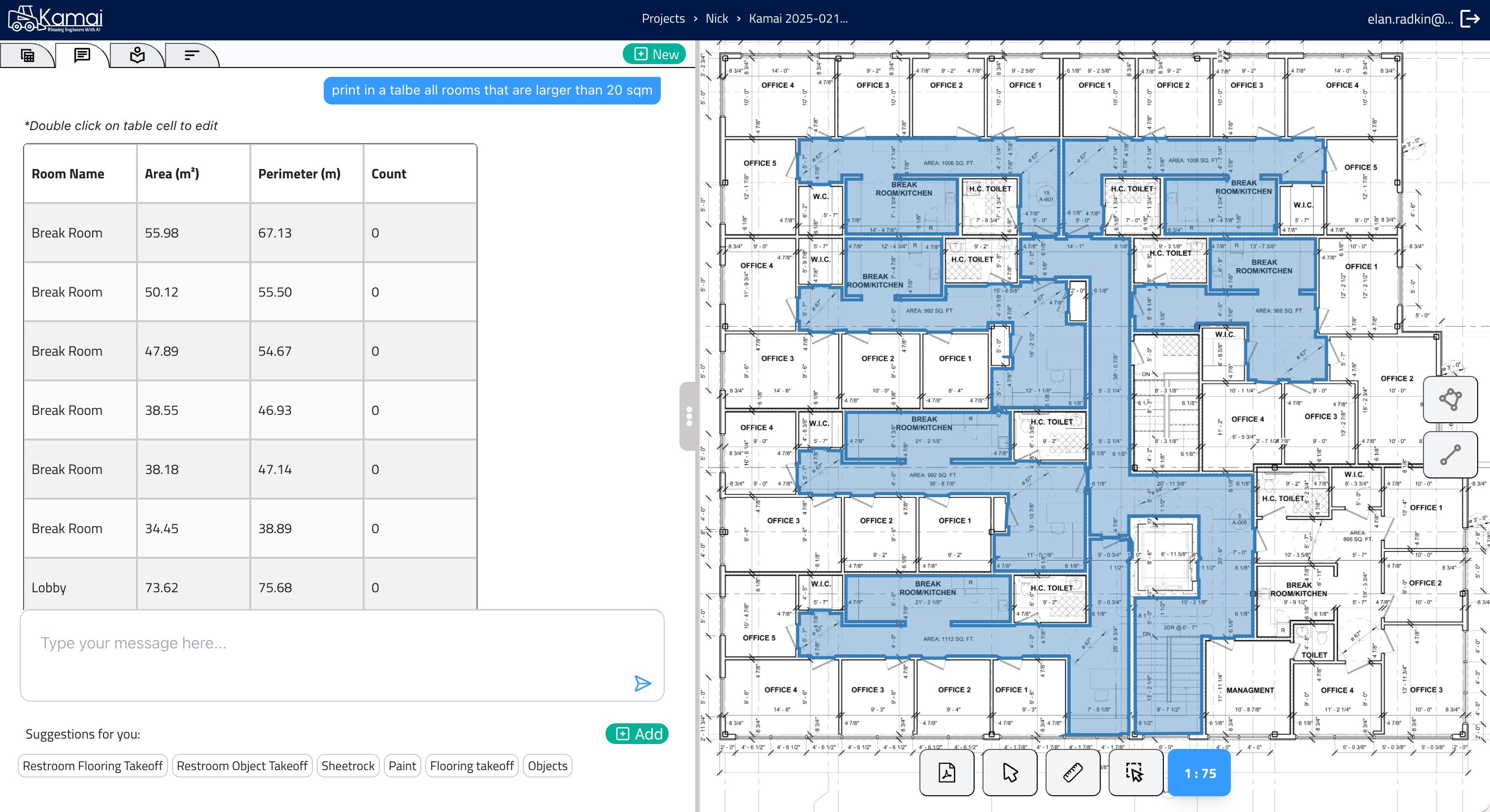
With traditional workflows, finding specific information requires scanning through drawings or spreadsheets manually. With Kamai, users can query their data directly using natural language.
For example, teams can instantly ask:
- What is the total wall area on Level 2?
- How many fixtures are included across all floors?
- Which rooms exceed a specific size?
This conversational approach eliminates the need for manual searching, saving time and improving accuracy when responding to RFIs or validating project scope.
Seamless Integration Into Estimating Workflows
A key advantage of using a Takeoff API is its ability to integrate directly into existing platforms. Kamai allows companies to embed takeoff functionality into their own software, creating a seamless workflow from plan upload to final estimate.
Instead of switching between tools, teams can:
- Upload drawings within their platform
- Generate quantities automatically
- Push data directly into estimating systems
- Maintain consistency across all project stages
This integration reduces friction, eliminates duplicate work, and ensures that all stakeholders are working with the same accurate data.
Improving Accuracy and Reducing Risk
In construction, small errors can have massive consequences. A missed measurement or incorrect quantity can lead to cost overruns, delays, and lost profits.
Kamai’s AI-driven approach minimizes these risks by automating calculations and standardizing outputs. Every measurement is consistent, traceable, and based on the same logic reducing variability across projects.
By improving accuracy at the takeoff stage, teams can:
- Create more reliable estimates
- Avoid costly rework
- Build stronger client trust
- Protect profit margins
Unlocking Faster Decision-Making
Speed is critical in construction, especially during the bidding phase. The faster a team can analyze plans and generate estimates, the more opportunities they can pursue.
With Kamai’s Takeoff API, decisions that once took days can now be made in minutes. Teams gain immediate visibility into project scope, costs, and requirements, allowing them to act quickly and confidently.
This speed doesn’t just improve efficiency it creates a competitive advantage.
Bridging the Gap Between 2D and Digital Construction
While technologies like BIM continue to evolve, 2D drawings remain a fundamental part of the construction process. The challenge is not replacing them, but making them more useful.
Kamai bridges this gap by transforming traditional blueprints into dynamic, data-driven assets. Instead of being static documents, plans become sources of intelligence that can be analyzed, shared, and integrated across workflows.
This approach allows construction teams to modernize their processes without abandoning familiar tools and formats.
The Future of Construction Estimating
The construction industry is moving toward a more data-driven future, where decisions are based on real-time insights rather than manual calculations. Takeoff APIs are at the center of this transformation.
By automating data extraction and enabling seamless integration, Kamai empowers teams to work smarter, faster, and more accurately. Estimators can focus on strategy instead of measurements, while project managers gain better visibility into costs and scope.
As projects become more complex and timelines more demanding, the ability to turn 2D plans into structured construction insights will no longer be optional it will be essential.
Conclusion
Kamai’s Takeoff API is redefining how construction teams interact with blueprints. By converting 2D drawings into structured, actionable data, it eliminates manual effort, improves accuracy, and accelerates decision-making.
From automated quantity takeoffs to real-time data querying and seamless integration, Kamai transforms static plans into powerful insights that drive better project outcomes.
For construction companies looking to scale, compete, and innovate, adopting a Takeoff API is not just an upgrade it’s a strategic advantage.