Extract Quantities from Floor Plans with PDF Takeoff API

April 10, 2026
Extract quantities from floor plans with Kamai’s PDF Takeoff API. Automate takeoffs, improve accuracy, and speed up construction estimating workflows.
In modern construction, speed and accuracy are no longer optional they are essential. As projects grow more complex and deadlines become tighter, construction teams must find smarter ways to extract insights from their drawings. Yet, many estimators still rely on manual methods to measure and calculate quantities from floor plans, a process that is both time-consuming and prone to error.
Kamai’s PDF Takeoff API is transforming this workflow by enabling teams to extract quantities from floor plans automatically. Instead of manually reviewing drawings, professionals can now convert static PDFs into structured, accurate data within minutes, unlocking a new level of efficiency in construction estimating.
Why Extracting Quantities from Floor Plans Matters
Every construction project begins with a clear understanding of scope, and that scope is defined by quantities. From flooring areas and wall lengths to fixtures and materials, accurate quantity extraction is the foundation of reliable estimates, budgets, and project plans.
When quantities are inaccurate, the consequences ripple across the entire project lifecycle. Underestimating materials can lead to delays and rushed procurement, while overestimating can inflate costs and reduce profitability. This is why extracting precise quantities from floor plans is one of the most critical steps in preconstruction.
However, traditional methods rely heavily on manual measurement, making it difficult to maintain consistency and accuracy across projects.
The Limitations of Manual Takeoffs
Manual takeoffs often involve zooming into PDF drawings, tracing elements, measuring dimensions, and double-checking calculations repeatedly. While experienced estimators can achieve reasonable accuracy, the process is inherently slow and susceptible to human error.
Large projects with multiple floor plans add another layer of complexity. Estimators must track measurements across dozens of sheets, reconcile revisions, and ensure nothing is missed. This not only consumes valuable time but also limits how many projects a team can handle.
In an industry where speed directly impacts competitiveness, manual workflows can quickly become a bottleneck.
What Is a PDF Takeoff API?
A PDF Takeoff API is a technology that allows construction platforms to automatically extract quantities from digital drawings. By integrating this capability into existing systems, companies can automate the takeoff process without relying on separate tools.
Kamai’s PDF Takeoff API uses advanced AI and computer vision to analyze floor plans and identify key elements such as walls, rooms, openings, and fixtures. Instead of simply reading text, it interprets the structure and geometry of the drawing to generate accurate measurements.
This allows teams to move from manual interpretation to automated data extraction, significantly improving both speed and reliability.
How Kamai Extracts Quantities from Floor Plans
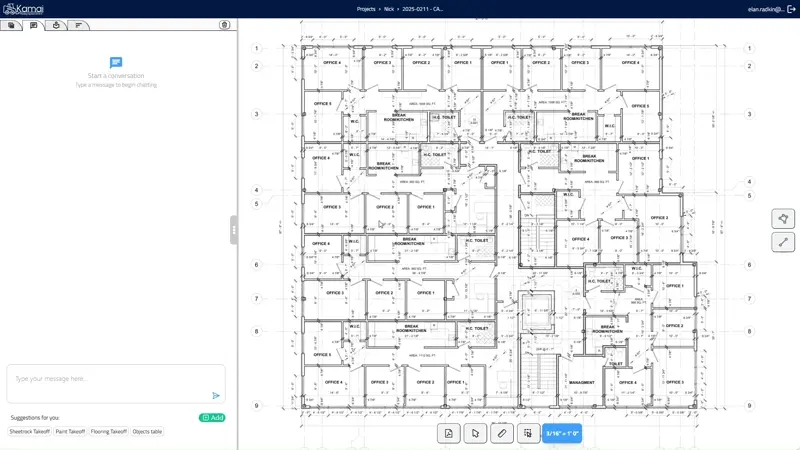
The process begins when users upload their floor plans in PDF format. Kamai instantly analyzes the drawings, recognizing patterns, symbols, and spatial relationships within the plan.
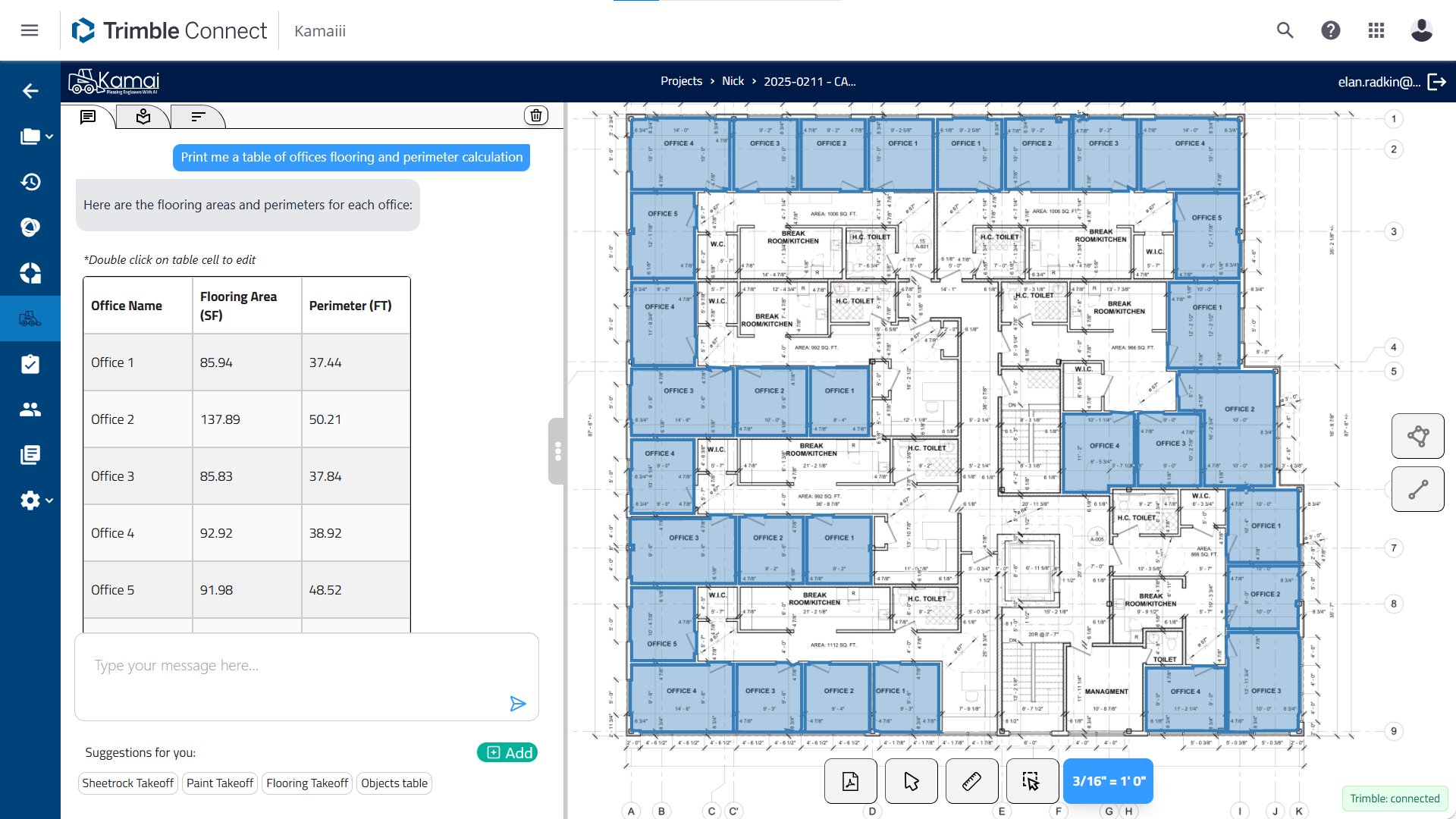
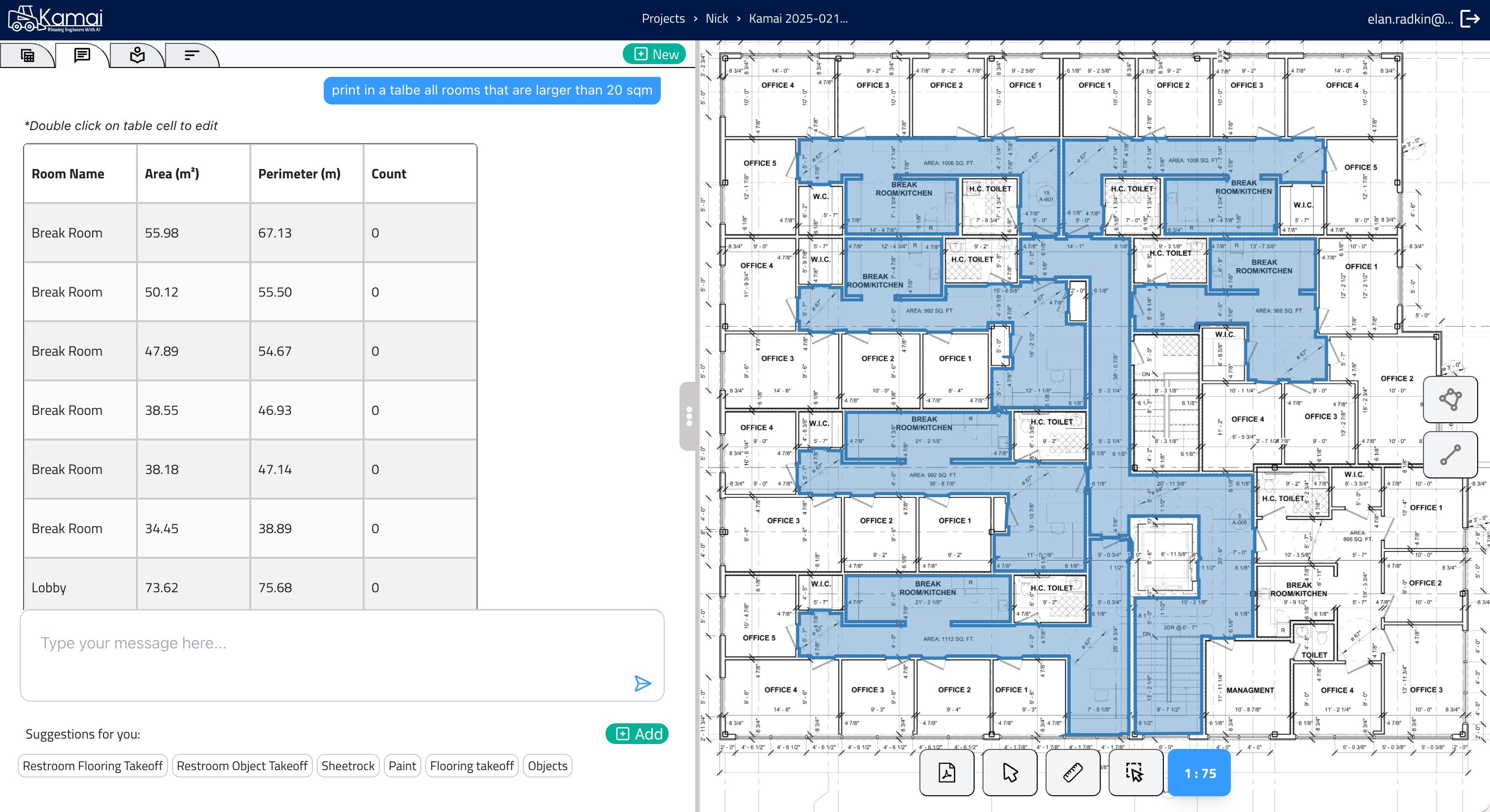
From there, the system identifies architectural and MEP elements and calculates quantities such as floor areas, wall surfaces, perimeters, and component counts. These calculations are performed automatically, eliminating the need for manual tracing or measurement.
What sets Kamai apart is its ability to transform this information into structured data. Instead of delivering raw measurements, the platform organizes quantities into clear, usable formats that can be directly applied to estimating workflows.
Turning Floor Plans into Structured Data
Floor plans are rich in information, but without structure, that information is difficult to use effectively. Kamai bridges this gap by converting visual data into organized datasets.
Rooms can be categorized, materials can be grouped, and quantities can be mapped to specific project components. This structured approach allows teams to analyze their data more efficiently and integrate it seamlessly into other systems.
By turning floor plans into structured data, Kamai enables better decision-making at every stage of the project.
Accelerating the Estimating Process
One of the most significant advantages of using a PDF Takeoff API is the speed it brings to estimating. Tasks that once took hours or days can now be completed in minutes.
Estimators can quickly generate accurate quantities and move directly into cost analysis, vendor coordination, and bid preparation. This not only reduces turnaround time but also allows teams to handle more projects without increasing workload.
Faster estimating means more opportunities to bid, improved responsiveness to clients, and a stronger competitive position in the market.
Enhancing Accuracy and Consistency
Accuracy is critical in construction estimating, and even small errors can lead to major financial consequences. Kamai’s automated approach reduces the risk of mistakes by standardizing how quantities are calculated.
Every measurement is based on consistent logic, ensuring that results are reliable across different projects and teams. This level of consistency is difficult to achieve with manual methods, where variations in approach can lead to discrepancies.
With Kamai, teams can trust that their data is precise, complete, and ready to support confident decision-making.
Supporting Complex and Multi-Sheet Projects
Modern construction projects rarely involve a single floor plan. Instead, they consist of multiple drawings across different levels and disciplines.
Kamai’s PDF Takeoff API is designed to handle this complexity by processing entire plan sets rather than individual sheets. It recognizes relationships across drawings, ensuring that quantities are consistent and comprehensive.
This capability eliminates the need for manual aggregation and allows teams to maintain a clear, unified view of project data.
Seamless Integration into Existing Workflows
One of the key benefits of Kamai’s PDF Takeoff API is its ability to integrate directly into existing platforms. Construction companies can embed takeoff functionality within their own systems, creating a seamless workflow from plan upload to final estimate.
This eliminates the need to switch between tools or manually transfer data. Quantities can be generated, analyzed, and applied within a single environment, improving efficiency and reducing the risk of errors.
Integration also ensures that all stakeholders have access to the same accurate data, enhancing collaboration across teams.
From Static Drawings to Intelligent Insights
Traditional floor plans are static documents that require interpretation. Kamai transforms them into dynamic sources of intelligence that can be analyzed, queried, and applied in real time.
Teams can gain immediate insights into project scope, identify potential risks, and make informed decisions without delay. This shift from manual analysis to automated intelligence represents a fundamental change in how construction projects are planned and executed.
The Future of Quantity Extraction in Construction
As the construction industry continues to evolve, the demand for faster, more accurate data will only increase. PDF Takeoff APIs are at the forefront of this transformation, enabling teams to unlock the full value of their drawings.
Kamai is leading this change by providing a solution that not only automates quantity extraction but also enhances the entire estimating workflow. By turning floor plans into structured, actionable data, it empowers construction professionals to work smarter and achieve better outcomes.
Conclusion
Extracting quantities from floor plans is a critical step in construction estimating, but traditional methods are no longer sufficient for today’s demands. Kamai’s PDF Takeoff API offers a faster, more accurate, and more scalable solution.
By automating the extraction process and transforming drawings into structured data, Kamai enables teams to reduce manual effort, improve accuracy, and accelerate decision-making. The result is a more efficient estimating process and a stronger foundation for successful construction projects.