
What Is 2D Takeoff and Why It Still Matters

kamai.io
May 5, 2026
5 Min
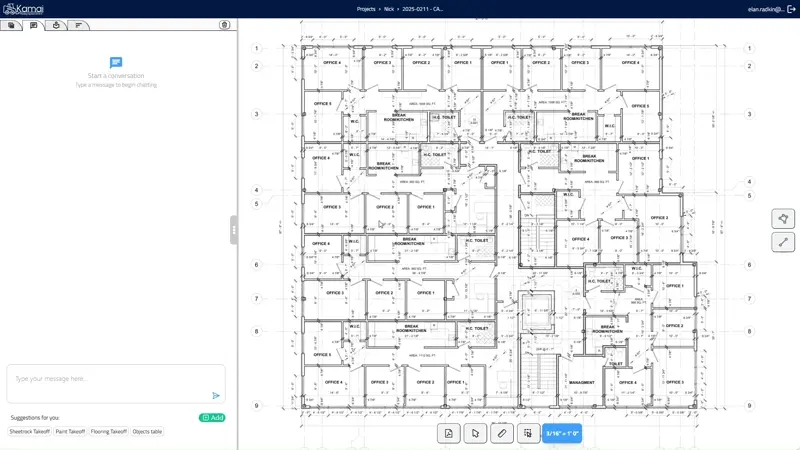
Learn what 2D takeoff is and why it still matters in construction. Discover how Kamai turns PDF plans and drawings into accurate structured data for faster estimates.
In construction technology conversations, it often sounds like every project now runs on fully connected BIM models, real-time digital twins, and advanced data ecosystems. While that may be the long-term direction of the industry, the day-to-day reality on most projects looks very different.
Across residential, commercial, renovation, and tender environments, estimators, General Contractors, subcontractors, and planners still rely heavily on PDFs, CAD exports, scanned plans, and traditional 2D drawings. These files remain the most common source of project information used during bidding, budgeting, procurement, and early planning.
That is why 2D takeoff continues to matter.
2D takeoff is the process of measuring quantities directly from two-dimensional drawings such as PDFs, scanned blueprints, or CAD sheets. It remains one of the most practical and widely used workflows in construction estimating because it is fast, familiar, accessible, and often the only available source of scope information.
Even as BIM adoption grows, 2D takeoff is still essential for accurate pricing and profitable decision-making.
What Is 2D Takeoff?
2D takeoff converts visual plan information into measurable quantities. Estimators review floor plans, elevations, sections, reflected ceiling plans, or trade drawings and calculate the quantities needed to prepare a cost estimate.
This often includes:
- Flooring areas
- Ceiling areas
- Paintable wall surfaces
- Internal wall lengths
- Concrete slab areas
- Perimeter measurements
- Door and window counts
- Fixtures and outlets
- Pipe or duct runs
- Room-by-room quantities
- Finish schedules and scope totals
Traditionally, this was completed manually using printed drawings, rulers, coloured markers, and calculators. Today, many teams perform 2D takeoff digitally using software that measures directly from PDF plans.
Regardless of the method, the purpose remains the same: turn drawings into numbers that can be priced accurately.
Why 2D Drawings Still Dominate Real Projects
There is often a gap between ideal digital workflows and real-world project delivery. Many businesses talk about model-based estimating, but a large portion of projects still begin with static documentation.
Why? Because 2D drawings remain practical, familiar, and contractually reliable.
Universally Available: Even small and mid-sized projects usually provide 2D plans. Many consultants issue PDF sets as the standard package for tendering and approvals.
Faster to Distribute: PDF drawings are easy to email, upload, review, print, and share across teams.
Better for Notes and Detail Callouts: Many important instructions still live inside notes, legends, schedules, and annotations on 2D sheets.
Common During Tender Phase: Fully developed BIM models are not always available when bids are due. Estimators often receive early drawing packages and tight submission deadlines.
Easier for Field Teams: Supervisors, trades, and subcontractors frequently still use drawings on tablets or printed sheets for day-to-day execution.
Because of these realities, 2D takeoff remains deeply relevant.
Why 2D Takeoff Matters Financially
An estimate is only as accurate as the quantities behind it. If quantities are wrong, labour budgets, procurement plans, and bid margins quickly become unreliable.
That makes 2D takeoff one of the most financially important tasks in preconstruction.
For example:
- Undermeasured flooring can create direct material losses
- Missed wall areas can underprice painting scope
- Incorrect fixture counts can affect electrical packages
- Overestimated materials can make bids uncompetitive
- Poor room-by-room takeoffs can delay procurement planning
In competitive markets with thin margins, these mistakes can determine whether a project becomes profitable or problematic.

Why 2D Takeoff Solves Everyday Jobs
Imagine a mid-size office renovation project. The architect provides only PDF floor plans, reflected ceiling plans, and finish schedules. There is no BIM model.
Can the project still be estimated accurately? Absolutely.
Using 2D takeoff, an estimator can:
- Measure carpet replacement areas
- Calculate paintable wall surfaces
- Count new doors and glazing items
- Quantify suspended ceiling areas
- Review partition wall lengths
- Count fixtures for washroom upgrades
- Build room-by-room pricing summaries
Without 2D takeoff, many renovation, tenant improvement, and fast-track jobs would be impossible to price efficiently.
The Data Gap in Traditional 2D Workflows
Although 2D plans are common, traditional workflows often create a serious data gap.
Important information is locked inside lines, symbols, scales, and annotations. Estimators must manually interpret that information and convert it into spreadsheets. This process can be slow, repetitive, and vulnerable to mistakes.
Common challenges include:
- Manual measuring across many sheets
- Re-entering quantities into spreadsheets
- Missing revisions or updated drawings
- Inconsistent takeoff methods between estimators
- Difficulty summarizing multi-floor projects
- Limited visibility across trades and zones
As projects grow more complex, manual 2D workflows become harder to manage.
How Kamai Modernizes 2D Takeoff
Kamai helps construction teams keep the advantages of 2D drawings while removing the inefficiencies of manual workflows.
Using AI and computer vision, Kamai transforms PDFs, scanned plans, and blueprint sets into structured construction data. Instead of only reading text, the platform recognizes geometry, symbols, rooms, walls, fixtures, and measurable plan elements.
That means estimators can upload drawings and receive organized quantities much faster.
Kamai can help extract:
- Flooring and ceiling areas
- Wall lengths and surface areas
- Door and window counts
- Fixture totals
- Room-based data
- Perimeter dimensions
- Multi-sheet project summaries
- Export-ready takeoff tables
This turns static plans into usable estimating intelligence.
Why 2D Takeoff + AI Is Powerful
Some businesses assume the future means abandoning 2D plans entirely. In reality, the smarter approach is improving existing workflows.
Most companies already receive PDFs. Most estimators already understand drawings. Most bids already depend on 2D packages.
That means combining familiar documentation with modern automation creates immediate value.
Benefits include:
- Faster estimating turnaround
- Reduced manual measurement time
- Better consistency across bids
- Easier handling of revisions
- More bid opportunities with the same team
- Structured data for downstream systems
Instead of forcing every project into a new process, Kamai upgrades the process teams already use.
2D Takeoff vs BIM: It Is Not Either/Or
Many people compare 2D takeoff and BIM as if one replaces the other. In practice, both can coexist.
BIM models may support design coordination, clash detection, and lifecycle planning. But 2D drawings still play a major role in tendering, validation, documentation, and contractual review.
Contractors often need independent quantity verification rather than relying solely on model outputs. Legacy buildings may have no model at all. Renovations frequently begin from existing plans or scanned drawings.
That is why 2D takeoff remains relevant even in advanced digital environments.
The Future of 2D Takeoff
2D takeoff is evolving from manual measurement into intelligent data extraction.
Instead of spending hours tracing plans, future workflows will increasingly involve:
- Uploading drawings instantly
- Auto-detecting measurable elements
- Querying plans with natural language
- Comparing revisions automatically
- Exporting structured quantities to estimating systems
- Generating insights across full drawing sets
Kamai is helping lead that transition by making 2D workflows smarter, faster, and more scalable.
Final Thoughts
2D takeoff is not outdated. It is still one of the most practical and necessary estimating workflows in construction today.
Most projects still rely on PDFs, CAD sheets, and static drawings. Many bids still depend on rapid quantity extraction from 2D plans. Many contractors still need accurate numbers before any model is available.
That is why 2D takeoff continues to matter.
With Kamai, businesses can preserve the familiarity of 2D drawings while unlocking the speed and precision of AI-powered automation. Plans become structured data, takeoffs become faster, and estimates become stronger.
In a competitive industry, that combination creates real advantage.
%20(1080p)_153.jpg)
