Is Embedded Takeoff API suitable for all types of construction projects?

April 1, 2026
Is an embedded takeoff API suitable for all construction projects? Discover how Kamai transforms 2D blueprints into structured data for faster, accurate estimating.
The short answer is yes an embedded takeoff API is suitable for virtually all types of construction projects. From small residential builds to large-scale infrastructure developments, the ability to extract accurate data from drawings is a universal requirement.
However, to truly understand why this is the case, it’s important to look at the bigger challenge facing the industry today: the gap between static blueprints and dynamic, data-driven workflows.
From Static Blueprints to Dynamic Intelligence: Solving the Data Gap in Construction
The construction industry is steadily moving toward advanced digital workflows, including Building Information Modeling (BIM) and digital twins. These technologies promise fully integrated project lifecycles where every detail is connected and accessible in real time.
But the reality on most job sites is very different.
Estimators, general contractors, and planners still rely heavily on static documentation such as PDFs, scanned tender files, and 2D drawings. These formats remain the industry standard for bidding, validation, and execution.
This creates what can be called a “data gap.” Critical project information exists, but it is locked inside drawings lines, symbols, and annotations that require manual interpretation.
Even in highly digital environments, teams often need to fall back on 2D documentation for validation and contractual purposes. This is where an embedded takeoff API becomes essential.
The Industry Challenge: Why 2D Still Dominates
Despite the growth of BIM, 2D drawings continue to play a central role in construction workflows.
One of the main reasons is liability. Contractors cannot always rely solely on design models and must independently verify quantities to protect margins and reduce risk.
Another factor is complexity. Real-world construction involves more than just material quantities. Teams must evaluate constructability, logistics, and on-site conditions factors that often require detailed analysis of drawings.
The tender phase also reinforces the importance of 2D. During bidding, estimators typically work with incomplete or early-stage drawings, often provided as PDFs with tight deadlines.
Additionally, many projects involve existing structures without complete digital models. Legacy buildings, renovations, and partial datasets make 2D drawings unavoidable.
Because of these realities, the ability to extract accurate data from 2D inputs is critical for every type of construction project.
Why Embedded Takeoff API Works Across All Project Types
An embedded takeoff API, like the one provided by Kamai, is designed to work directly with the formats that construction teams already use.
Instead of requiring a full BIM environment, it operates on PDFs and scanned drawings, making it universally applicable.
Whether it’s a residential building, commercial development, industrial facility, or infrastructure project, the core requirement remains the same: converting drawings into accurate quantities and structured data.
Kamai’s API bridges this gap by transforming static blueprints into dynamic intelligence, making it suitable for all project types.
The Kamai Approach: Structured Data from 2D Inputs
Kamai uses advanced AI and computer vision to process construction drawings and extract meaningful data.
Unlike simple OCR tools, it understands the structure of drawings. It can differentiate between architectural elements, recognize MEP symbols, and interpret spatial relationships such as rooms and zones.
This allows it to convert raw 2D inputs into structured datasets that can be used for estimating, planning, and decision-making.
Automated Quantity Takeoffs
Kamai automates the entire quantity takeoff process.
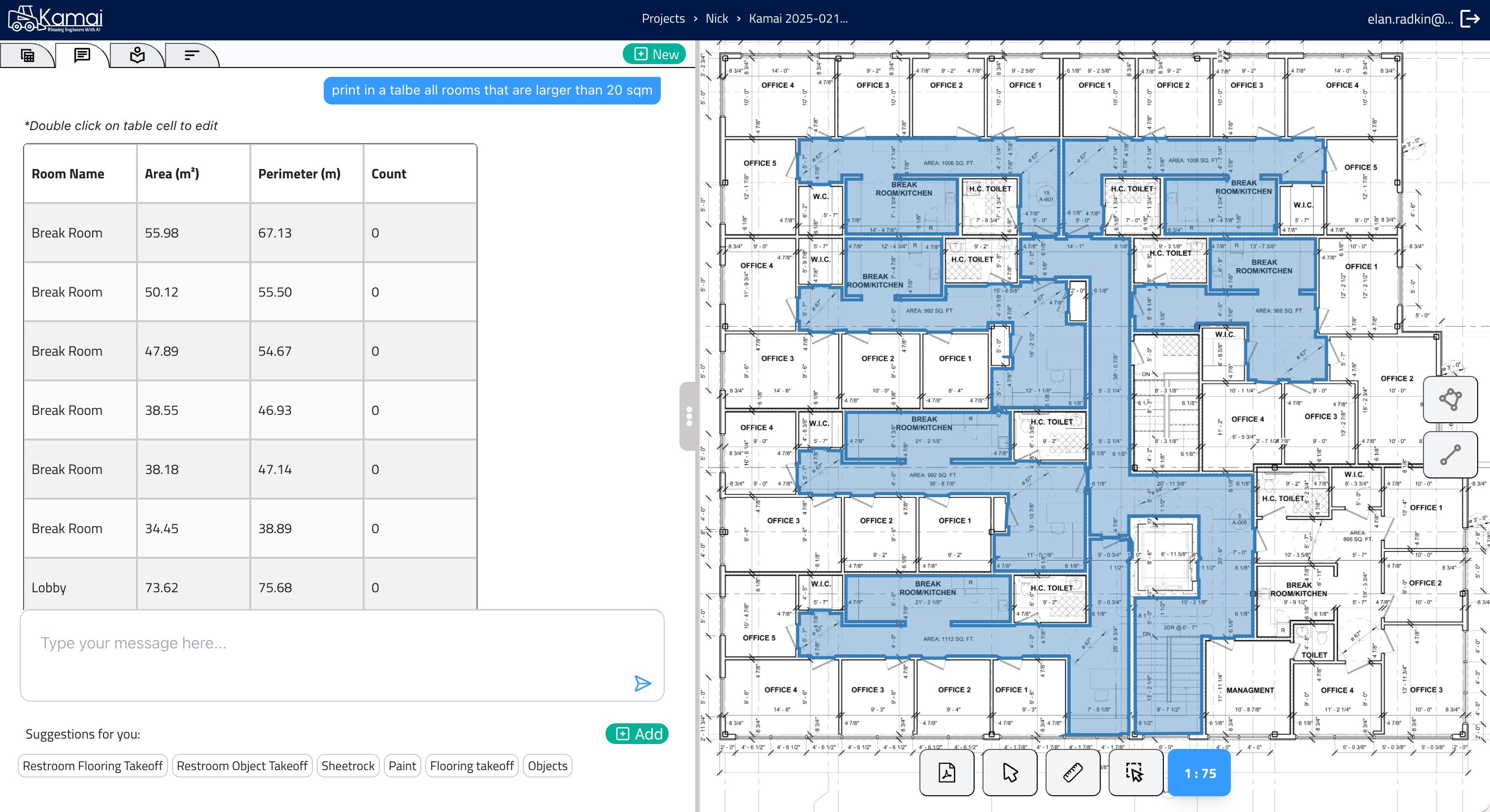
Users upload their plan sets, and the system immediately begins analyzing the drawings. It identifies geometry, detects patterns, and extracts key elements.
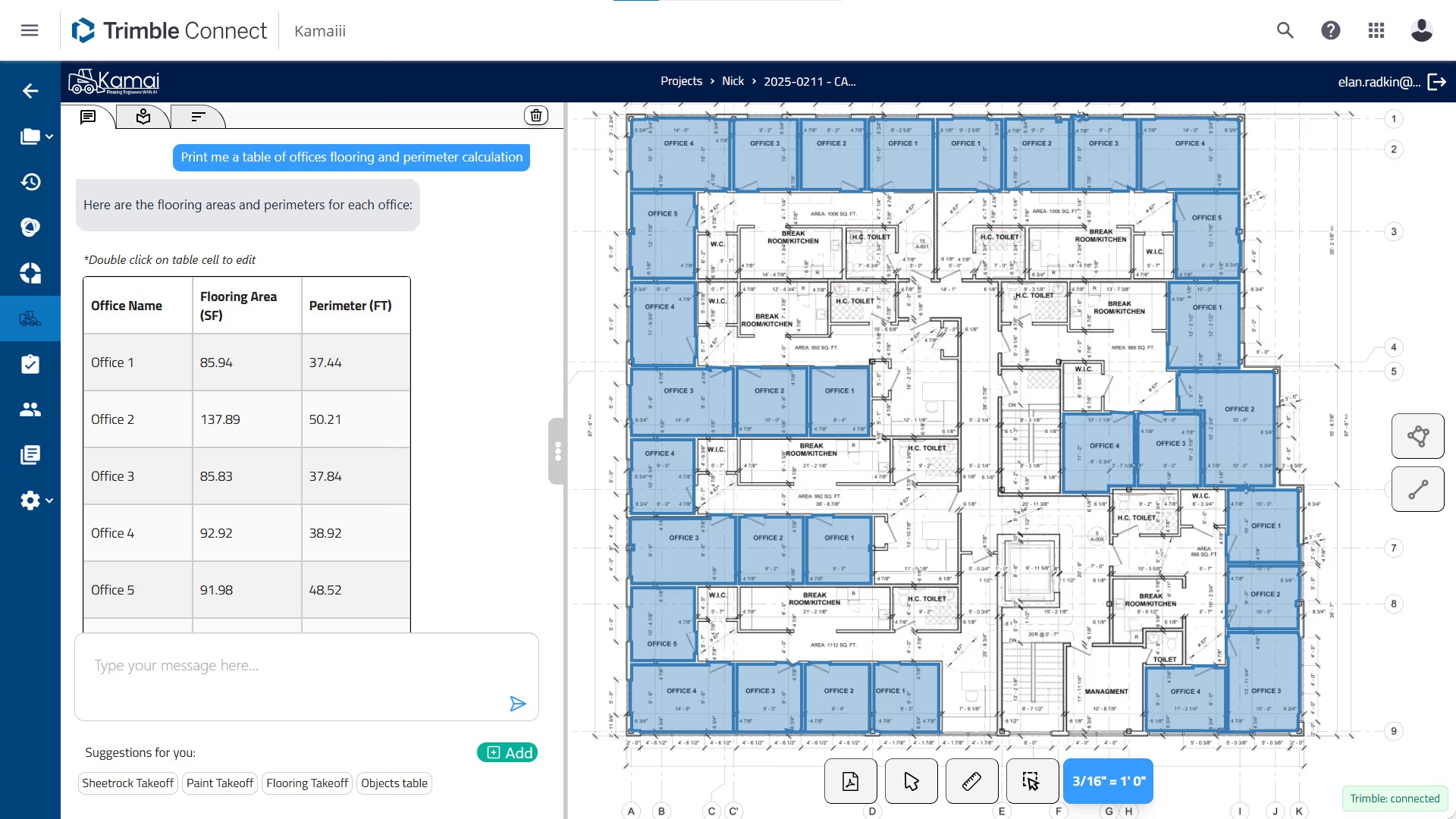
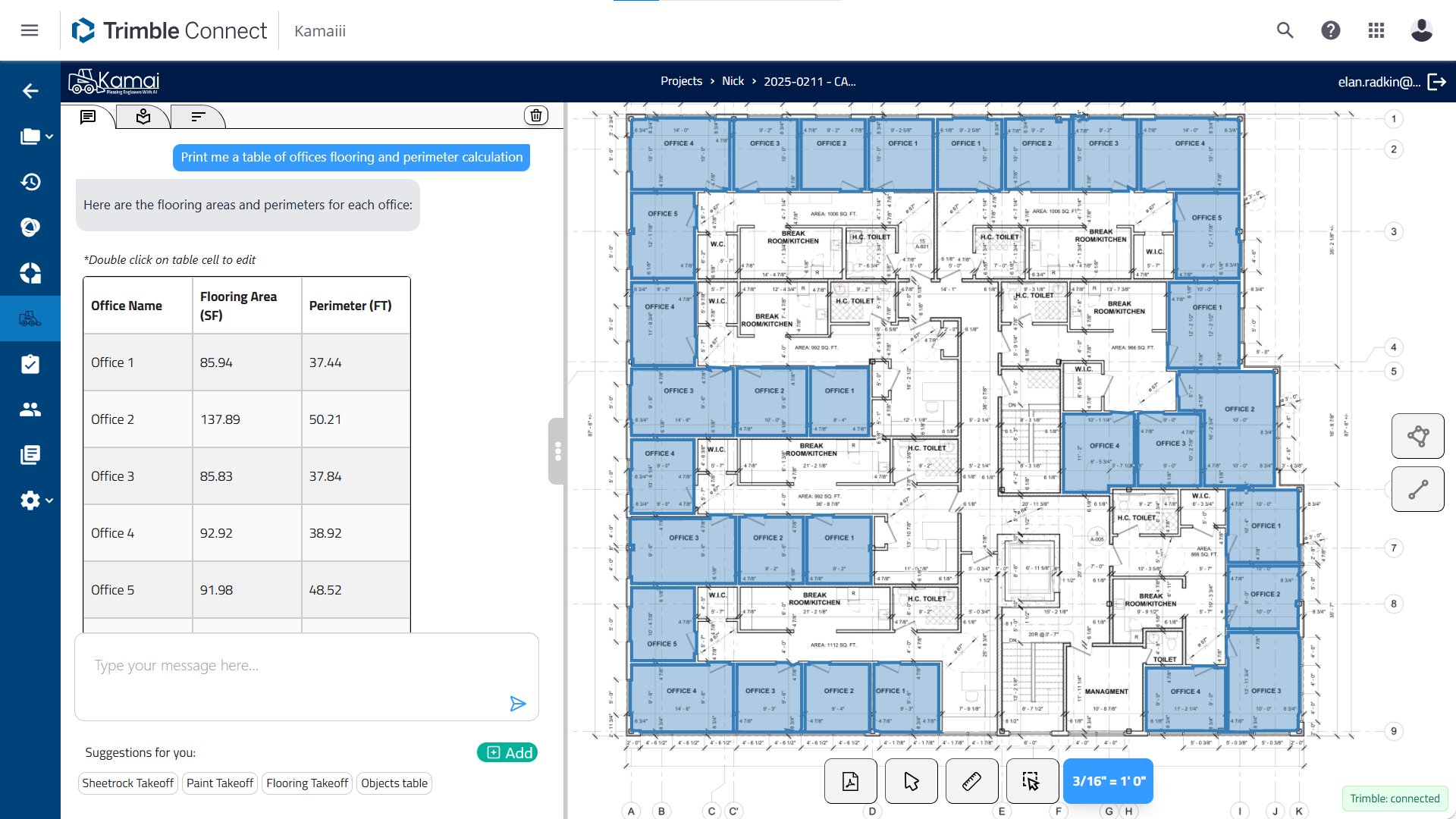
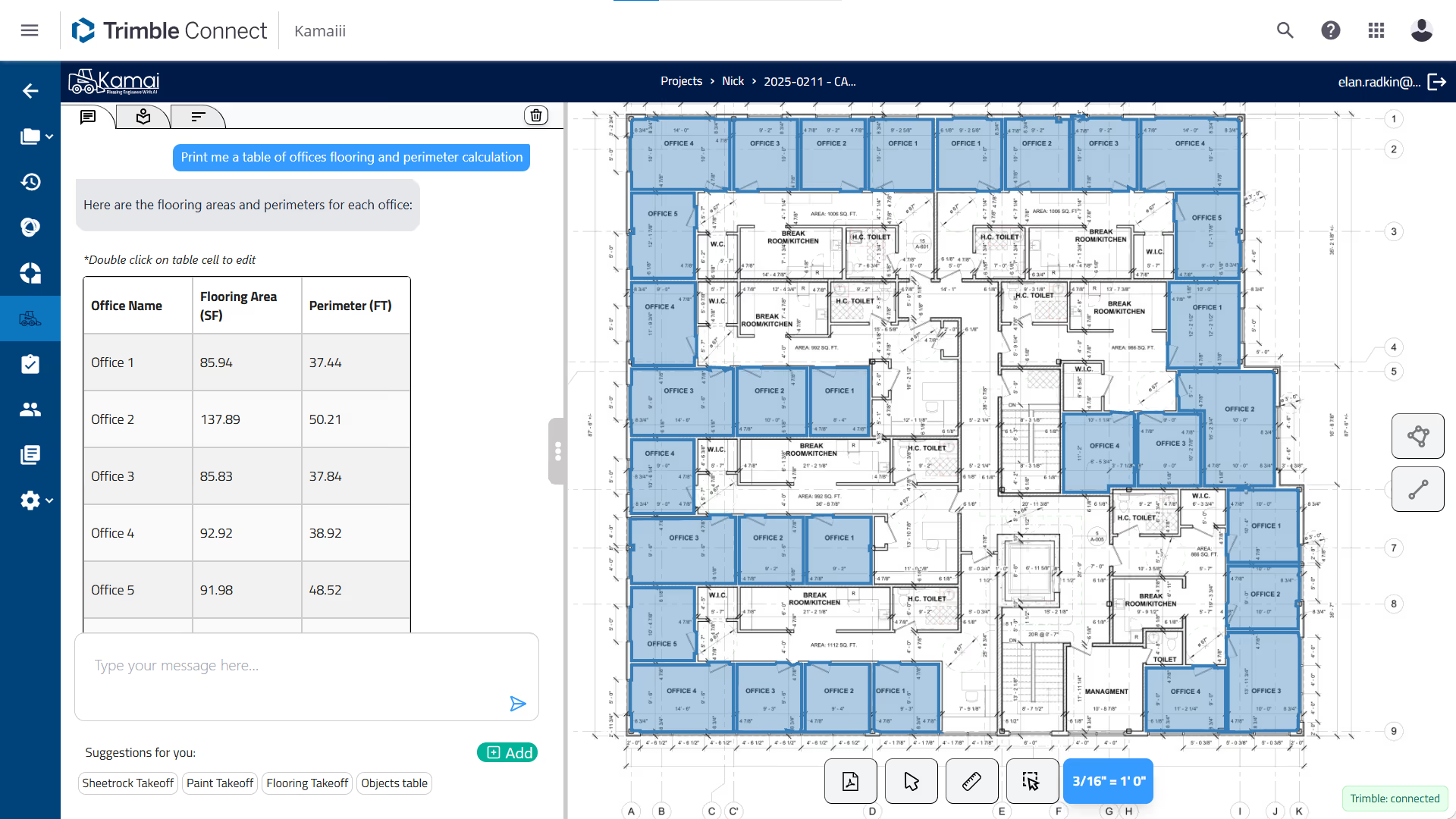
The result is a detailed dataset that includes areas, lengths, counts, and material quantities.
This applies to all types of projects, whether you are calculating flooring for a residential building or piping lengths for an industrial facility.
Multi-Sheet Processing for Full Projects
Construction projects rarely involve a single drawing.
Kamai is built to process entire drawing sets, not just individual sheets. It recognizes relationships between different plans and ensures consistency across the project.
This makes it ideal for complex developments with multiple floors, disciplines, and drawing types.
Instead of manually combining data from different sheets, the system provides a unified view of the entire project.
Turning Drawings into Queryable Data
One of the most powerful features of Kamai is its ability to transform drawings into a dataset that can be queried.
Instead of manually searching through plans or spreadsheets, users can ask questions and retrieve specific information instantly.
For example, teams can quickly identify room sizes, calculate total wall lengths, or summarize fixture counts across multiple drawings.
This capability significantly improves efficiency and supports faster decision-making across all project types.
Benefits Across Different Construction Sectors
The versatility of an embedded takeoff API becomes clear when you look at its benefits across different sectors.
Residential projects benefit from faster quantity calculations and accurate material planning.
Commercial developments gain efficiency in handling large and complex drawing sets.
Infrastructure projects benefit from the ability to process multi-discipline data and manage large-scale quantities.
Renovation and retrofit projects benefit from working with legacy drawings and incomplete data.
In every case, the ability to extract structured data from drawings is essential and Kamai delivers this capability consistently.
Eliminating Manual Work and Reducing Errors
Manual takeoffs are one of the biggest sources of inefficiency and error in construction.
They require time, attention, and repetition, and even then, mistakes can occur.
Kamai eliminates this burden by automating measurements and calculations.
This not only improves accuracy but also frees up teams to focus on higher-value tasks such as cost analysis and project planning.
Supporting Better Decision-Making
Construction decisions depend on accurate and timely data.
By converting drawings into structured information, Kamai enables teams to analyze projects more effectively.
Estimators can create more precise bids, project managers can plan resources more efficiently, and stakeholders can make informed decisions with confidence.
This data-driven approach is valuable for every type of construction project.
Bridging the Gap Between 2D and Digital Workflows
The future of construction is digital, but the present still relies heavily on 2D documentation.
Embedded takeoff APIs act as a bridge between these two worlds.
They allow companies to modernize their workflows without abandoning existing processes.
With Kamai, teams can continue working with PDFs and drawings while gaining the benefits of automation and structured data.
Conclusion
So, is an embedded takeoff API suitable for all types of construction projects?
Yes because every project relies on accurate data from drawings, and every project faces the same challenges of manual interpretation and inefficiency.
Kamai addresses these challenges by transforming static blueprints into dynamic, structured data that can be analyzed, shared, and used for better decision-making.
By bridging the gap between traditional workflows and modern technology, Kamai ensures that construction teams can work faster, smarter, and more accurately no matter the project type.