How to Do a Construction Takeoff Step by Step

March 10, 2026

Learn how to do a construction takeoff step by step and see how Kamai transforms blueprints into structured data for accurate estimating and preconstruction planning.
Construction projects do not begin with materials or labor on site. They begin with information. Before a contractor can submit a bid, order materials, or assign crews, they must understand exactly what needs to be built. That understanding starts with a construction takeoff.
A well-executed construction takeoff ensures that the visual intent shown in drawings becomes measurable, traceable, and cost-ready data. Without it, estimates rely on assumptions. With it, projects gain clarity, control, and predictability.
Modern platforms like Kamai are transforming this process by helping teams extract structured data from drawings faster and with greater accuracy. But whether you are using digital tools or improving your workflow, understanding the step-by-step process of a construction takeoff is essential.
What Is a Construction Takeoff?
A construction takeoff is the systematic process of reviewing project drawings and specifications to identify, measure, and quantify all work required to build a project. It converts visual information into numeric quantities for materials, labor, and equipment.
These quantities become the foundation for estimating construction costs, planning procurement, forecasting labor hours, and supporting bid preparation, scope coordination, and cost control throughout preconstruction and execution.
Rather than a single action, a construction takeoff unfolds through a sequence of interconnected subprocesses. Each focuses on a specific dimension of scope, such as quantities, materials, assemblies, or systems. Together, they build a complete and structured view of what must be built, purchased, installed, and managed.
This structured approach ensures that planning decisions remain consistent and aligned across estimating, scheduling, and execution.
Step 1: Review the Project Documents Thoroughly
The first step in any construction takeoff is understanding the full scope of the project.
This includes reviewing architectural drawings, structural plans, mechanical and electrical layouts, specifications, schedules, and general notes. Skipping this stage can result in missed scope items and inaccurate quantities.
At this stage, the estimator must identify:
Project boundaries and phases
Material specifications
Special conditions or unique design requirements
Referenced details and cross-sections
A takeoff is only as accurate as the understanding behind it. Tools like Kamai assist in organizing digital drawings so teams can navigate complex plan sets efficiently and prepare for precise measurement.
Step 2: Define the Scope of Work Clearly
Before measurements begin, the scope must be clearly defined.
Is the takeoff for structural concrete only? Interior finishes? Full building scope? Mechanical systems? Civil works?
Clearly defining the scope prevents duplication and omissions.
In larger projects, scope is often divided by trade. Each trade performs its own takeoff to ensure clarity and accountability.
Kamai helps structure this process by organizing extracted data into categories, making it easier to separate trades and maintain scope alignment.
Step 3: Identify Measurement Units and Standards
Every construction element must be measured in the correct unit.
Concrete is typically measured in cubic meters or cubic yards. Drywall is measured in square meters or square feet. Rebar may be measured by weight or linear length.
Standardizing units before measurement ensures consistency and simplifies cost calculation later.
Digital tools like Kamai automatically apply measurement logic as quantities are extracted, reducing the risk of inconsistent units.
Step 4: Begin Quantifying Major Components
Once preparation is complete, the estimator begins quantifying major components.
This typically starts with structural elements such as:
Foundations
Slabs
Columns
Beams
Load-bearing walls
These items form the backbone of the structure and significantly impact cost.
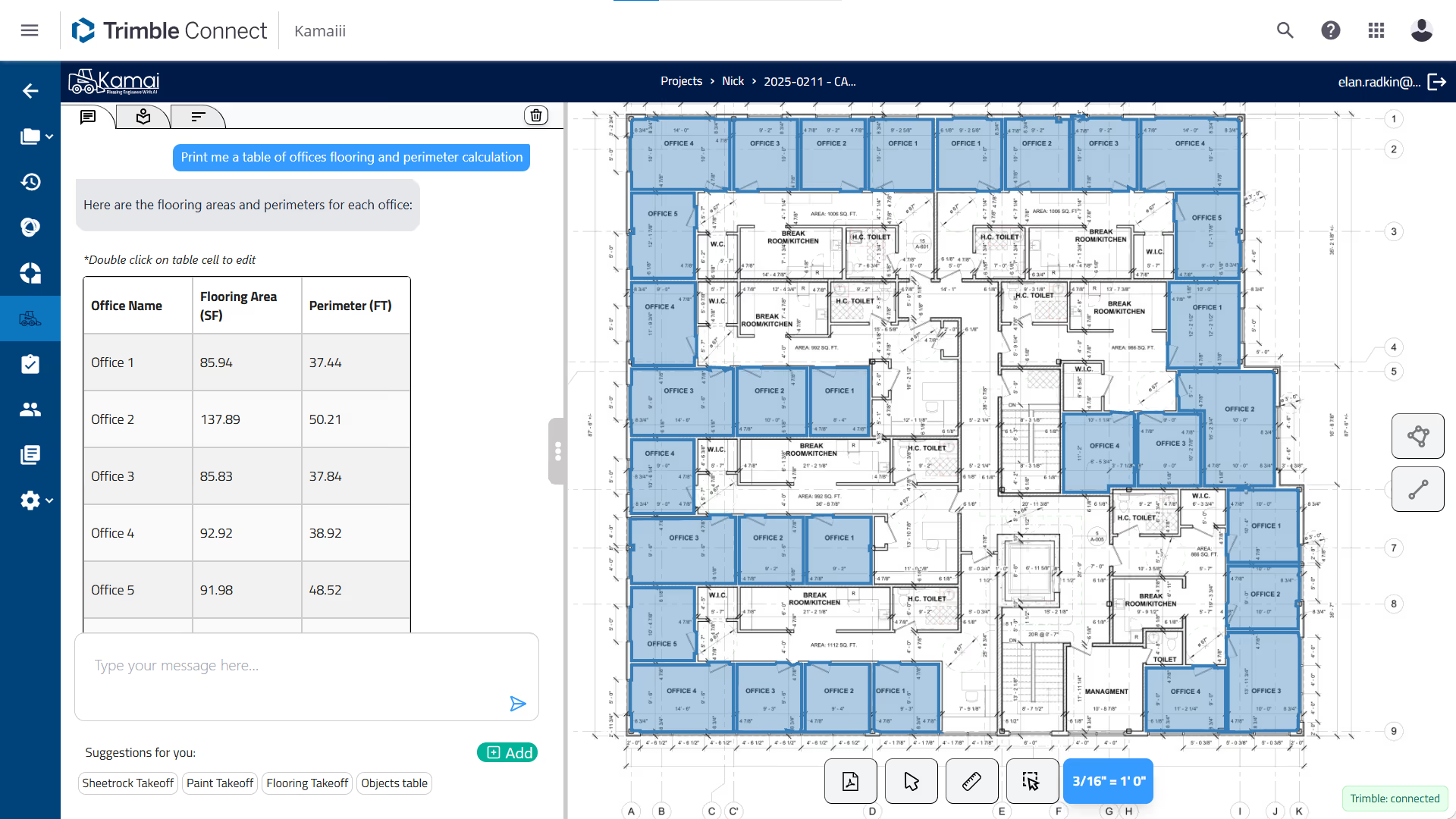
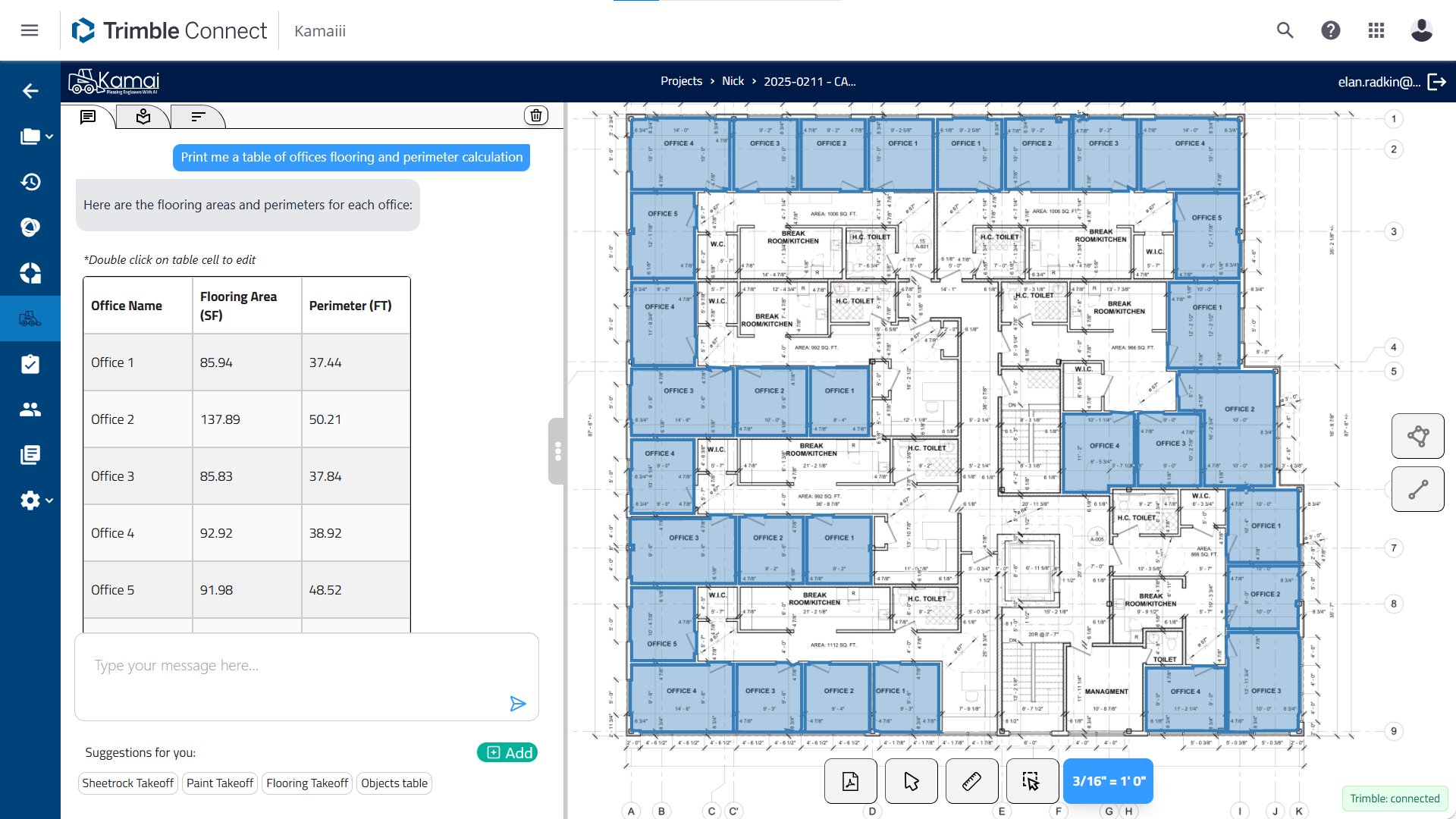
In manual workflows, estimators measure directly from scaled drawings. In digital workflows, Kamai enables point-and-click precision directly within PDF plans, calculating areas, volumes, and lengths in real time.
This eliminates manual math and speeds up the process considerably.
Step 5: Quantify Secondary and Finish Elements
After structural components are measured, secondary systems and finishes are quantified.
This includes:
Interior partitions
Ceilings
Floor finishes
Doors and windows
Fixtures and fittings
Each category requires careful attention to detail, especially when drawings include multiple revisions or complex layouts.
Kamai helps extract data from blueprints with enhanced speed and accuracy, turning complex plan sets into structured quantities that are easier to review and verify.
Step 6: Account for Labor and Equipment Requirements
A construction takeoff is not limited to materials. It also informs labor and equipment planning.
Once quantities are determined, labor productivity rates are applied to calculate required work hours. Equipment needs are assessed based on scope and project duration.
This stage connects takeoff data directly to estimating.
With integrated systems like Kamai, quantities flow directly into cost calculations, allowing labor and equipment forecasts to update automatically as measurements change.
Step 7: Apply Waste Factors and Adjustments
No construction project operates without material waste.
Estimators must account for:
Material cutting waste
Breakage
Overlaps
Spillage
Site conditions
Waste percentages vary by material type and project complexity.
Applying these adjustments ensures realistic procurement planning.
Kamai allows stored templates and formulas to apply waste factors consistently across projects, reducing variability and improving accuracy.
Step 8: Cross-Check and Validate Quantities
Validation is a critical step in the takeoff process.
Quantities should be reviewed against specifications and drawings to confirm completeness. Overlooking a single scope area can significantly impact project costs.
Digital tools make validation easier by organizing structured data in a clear format.
Kamai transforms blueprint chaos into structured data, making it easier to review quantities systematically and trace them back to their source drawings.
This traceability reduces risk and increases confidence in the final estimate.
Step 9: Link Quantities to Cost Data
Once quantities are verified, they are linked to pricing information.
This includes:
Material unit costs
Labor rates
Equipment costs
Subcontractor quotes
This step converts numeric quantities into a full construction estimate.
With Kamai’s integrated takeoff and estimating capabilities, costs update in real time as measurements are performed. This eliminates the need to export data into separate software.
The result is faster and more reliable cost forecasting.
Step 10: Prepare Bid Documentation
The final stage of the construction takeoff process supports bid preparation.
Accurate quantities allow contractors to:
Build detailed estimates
Prepare competitive bids
Clarify scope assumptions
Support value engineering decisions
Takeoff data becomes the backbone of the bid submission.
Kamai ensures that extracted quantities remain organized and accessible, supporting clear communication with project stakeholders.
Why Step-by-Step Structure Matters
Construction takeoff is not a single measurement activity. It is a structured workflow designed to align design intent with measurable scope.
Each step builds on the previous one:
Document review ensures understanding.
Scope definition prevents duplication.
Measurement generates reliable quantities.
Validation ensures completeness.
Cost linking transforms data into financial insight.
When performed systematically, takeoff supports consistent decision-making across estimating, scheduling, and execution.
Manual vs Digital Takeoff Approaches
Traditionally, takeoffs were performed manually using printed drawings, scale rulers, and spreadsheets.
While still possible, manual workflows are slower and more prone to error.
Digital platforms like Kamai modernize the process by:
Allowing direct measurement within PDFs
Automating calculations instantly
Converting drawings into structured data
Linking quantities directly to estimating
This integration reduces risk and increases productivity.
How Kamai Improves Every Step of Construction Takeoff
Kamai enhances each stage of the takeoff process.
During document review, digital organization simplifies navigation of large plan sets.
During measurement, AI-powered tools extract quantities quickly and accurately.
During validation, structured data makes cross-checking easier and more reliable.
During estimating, integrated cost calculations eliminate manual data transfer.
By transforming visual drawings into measurable data, Kamai supports smarter preconstruction workflows.
The Strategic Importance of Accurate Takeoffs
Accurate takeoffs influence every phase of a construction project.
They determine whether a contractor wins or loses a bid.
They impact procurement planning and material ordering.
They shape labor forecasting and scheduling.
They guide cost control decisions during execution.
An inaccurate takeoff can create cascading problems throughout the project lifecycle.
A precise and structured takeoff creates clarity and control from the beginning.
Conclusion: Building Success Starts with Accurate Takeoff
Learning how to do a construction takeoff step by step is fundamental to successful construction management.
From reviewing drawings to linking quantities to costs, each step plays a vital role in ensuring project accuracy and profitability.
Modern tools like Kamai elevate this process by extracting structured data from blueprints with enhanced speed and accuracy.
By combining systematic methodology with intelligent automation, construction teams can move from design intent to measurable scope confidently and efficiently.
Accurate takeoffs are not just about measurement. They are about building a reliable foundation for every decision that follows.