How much effort does embedded takeoff API require?

April 1, 2026
Learn how much effort it takes to integrate Kamai’s embedded takeoff API. Automate blueprint analysis, skip measurements, and get instant construction insights easily.
As construction companies and software platforms move toward automation, one question comes up frequently: how much effort does it actually take to implement an embedded takeoff API?
At first glance, integrating advanced takeoff capabilities into an existing system might seem complex. However, with modern solutions like Kamai, the process is far more straightforward than many expect. Designed for seamless integration and rapid deployment, Kamai enables teams to transform blueprint data into structured insights without heavy technical overhead.
Understanding Embedded Takeoff API Implementation
An embedded takeoff API allows you to integrate automated quantity takeoff capabilities directly into your platform, whether it’s estimating software, a project management system, or a custom-built construction tool.
Instead of relying on separate tools, your users can upload blueprints, extract quantities, and generate insights all within a single environment.
The effort required depends on several factors, including your current infrastructure, the level of customization needed, and how deeply you want to integrate takeoff functionality into your workflows.
However, with a well-designed API like Kamai’s, the implementation process is streamlined and developer-friendly.
The Traditional Complexity vs. Modern Simplicity
In the past, adding advanced functionality like automated takeoffs required building complex systems from scratch. This involved developing algorithms, handling drawing recognition, and ensuring accuracy across multiple project types.
Today, that complexity is handled by platforms like Kamai.
Instead of building everything internally, you can leverage Kamai’s ready-to-use API, which already includes advanced AI capabilities for blueprint analysis. This significantly reduces development time and effort.
Rather than months of development, integration can often be completed in a matter of days or weeks, depending on the scope.
What the Integration Process Typically Looks Like
Integrating an embedded takeoff API usually involves a few key steps.
First, developers connect their platform to the API using standard authentication and endpoints. This establishes communication between the system and Kamai’s services.
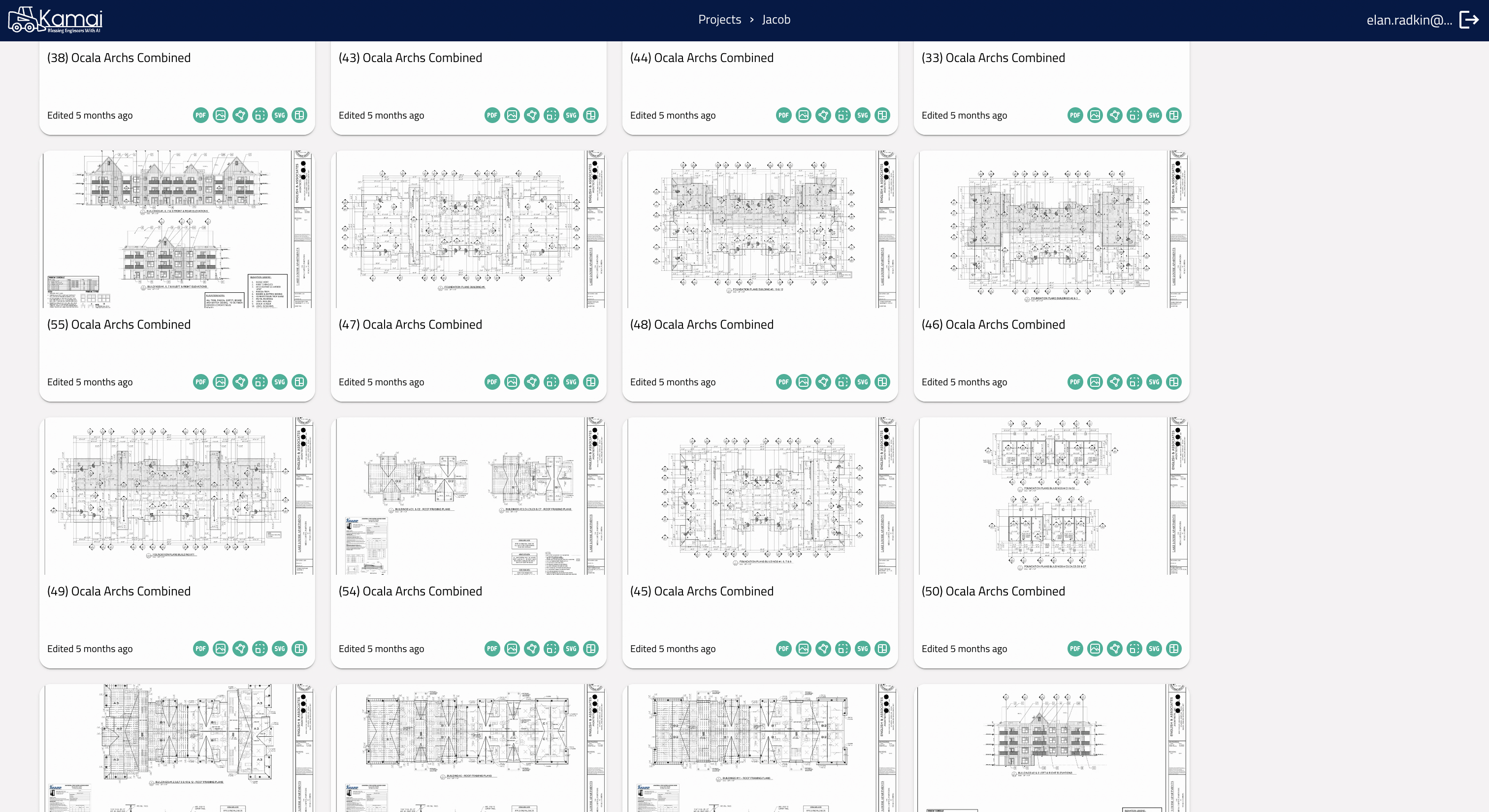
Next, the platform enables users to upload blueprint files, typically in PDF format. These files are then sent to the API for processing.
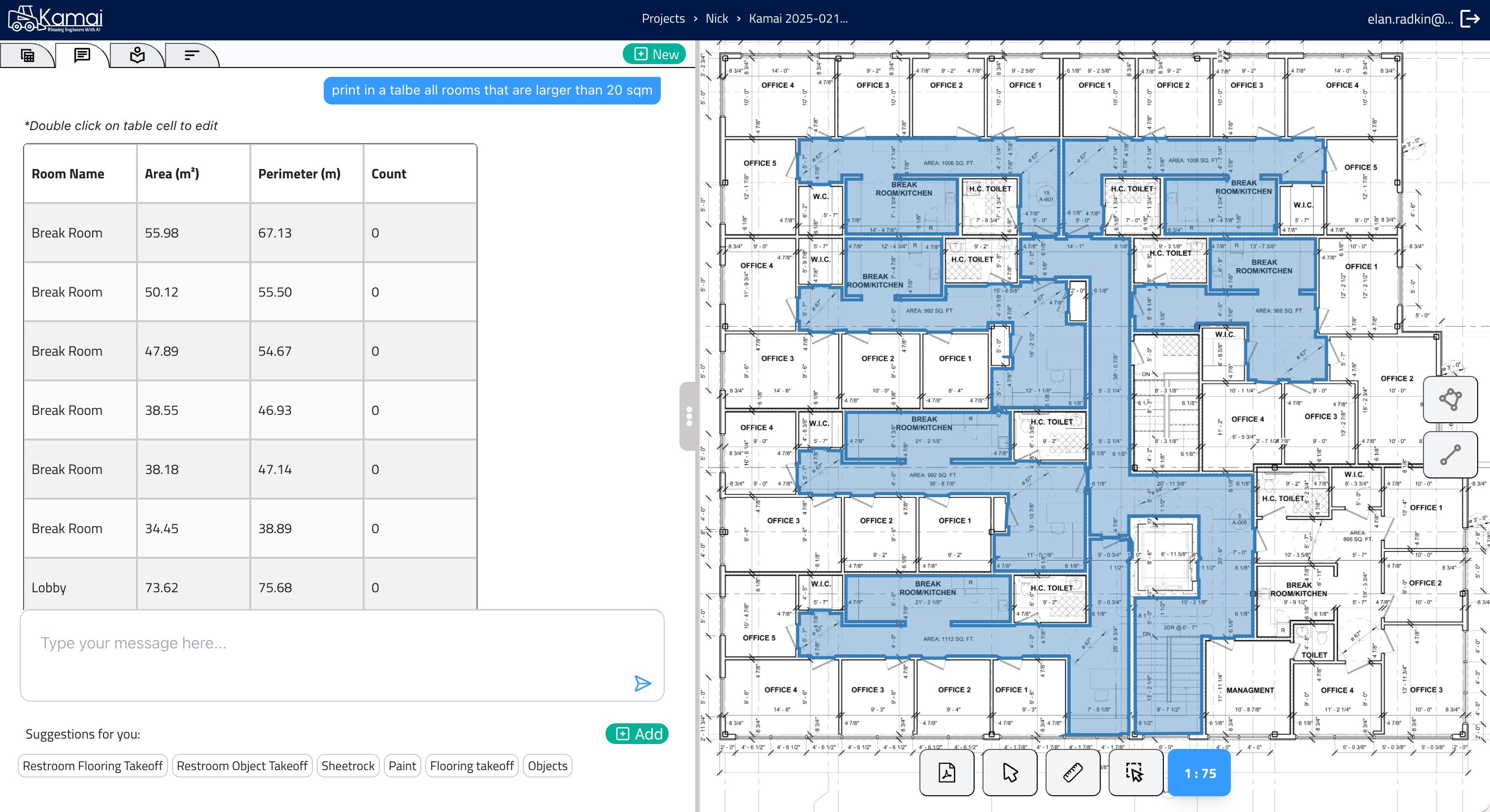
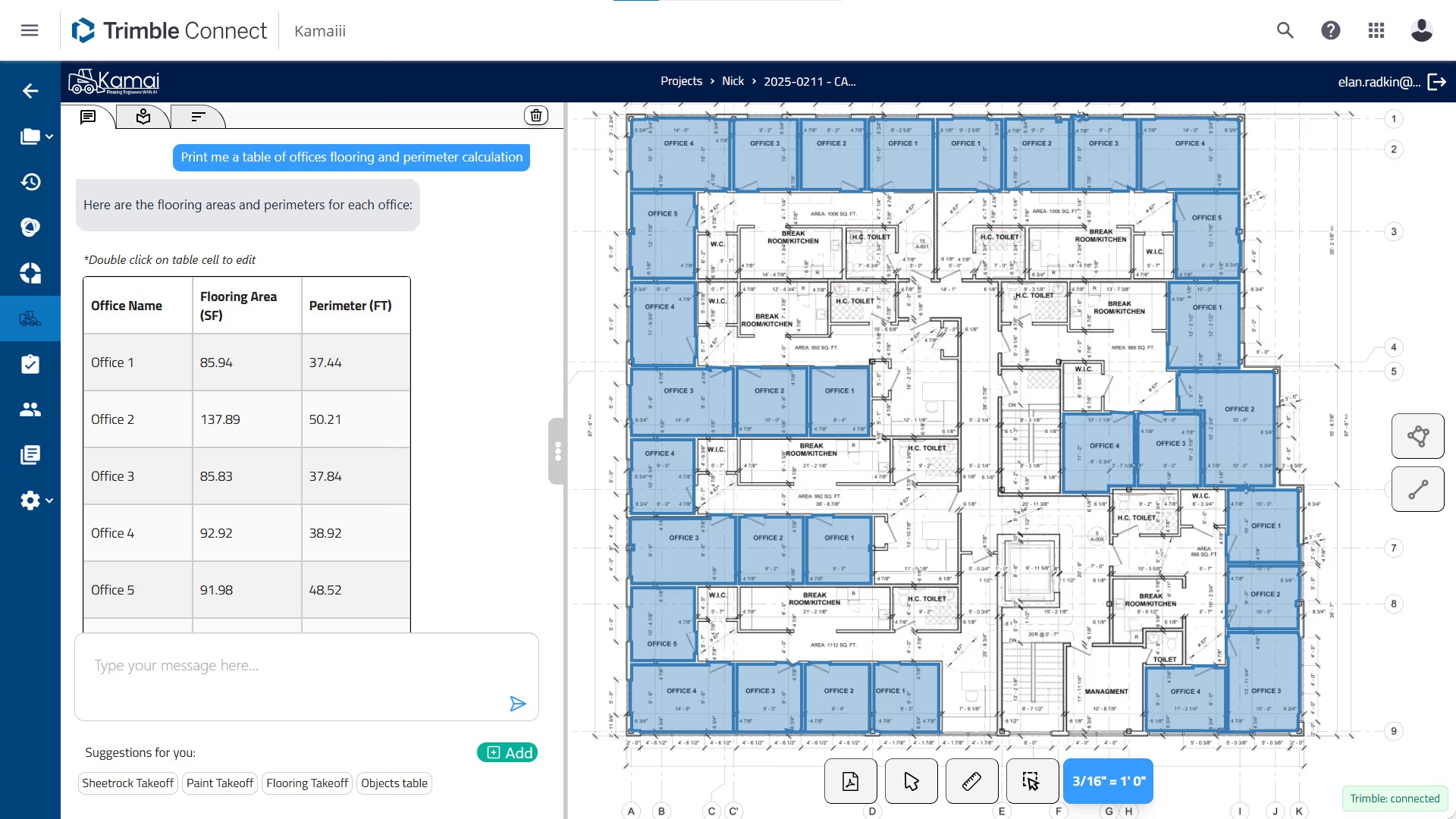
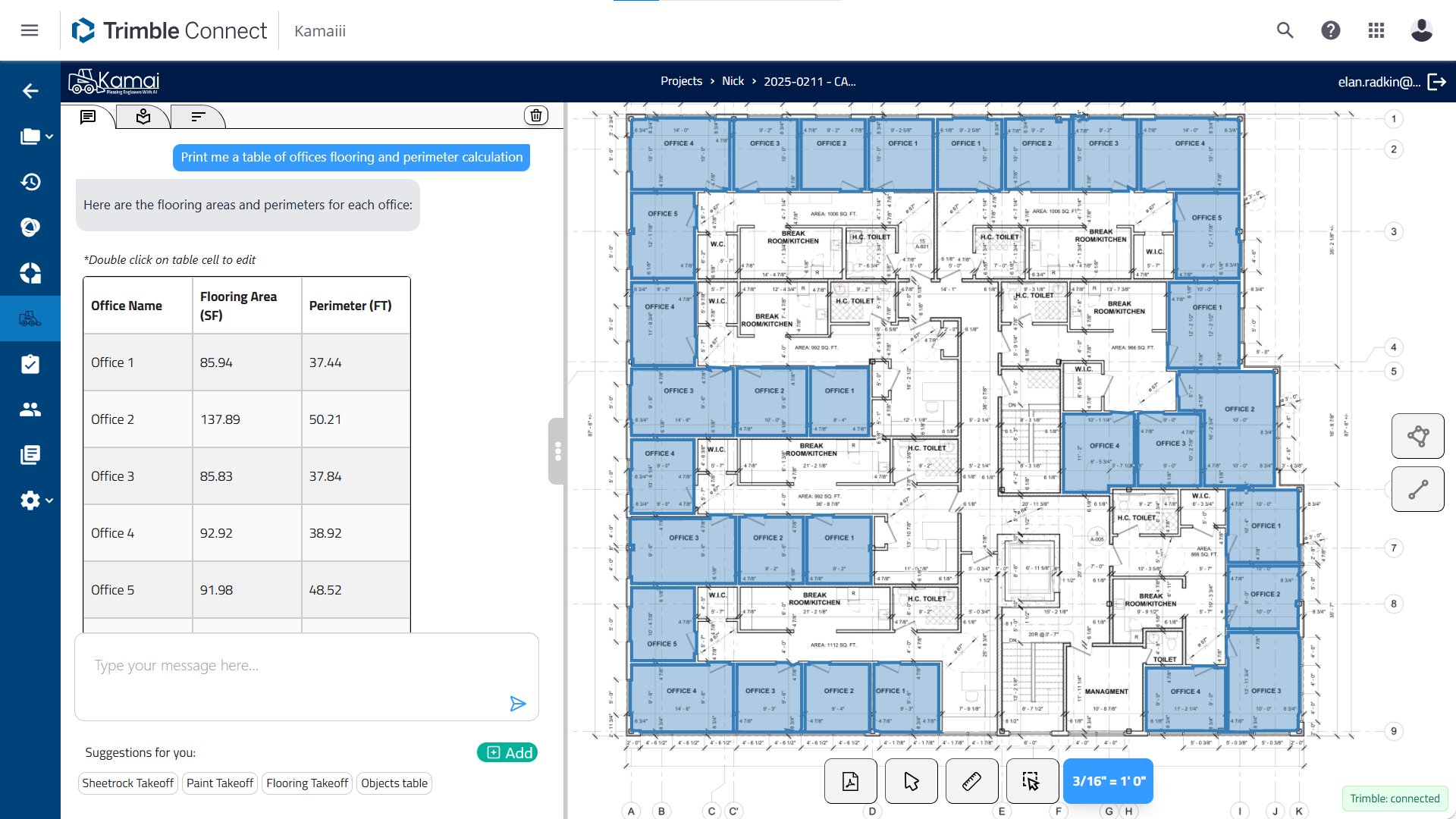
Kamai analyzes the drawings using AI, detecting elements such as walls, floors, openings, and materials. It calculates dimensions, areas, and volumes automatically.
Finally, the processed data is returned in a structured format, ready to be displayed, stored, or used in estimating workflows.
Because Kamai handles the heavy lifting, the integration focuses mainly on connecting inputs and outputs rather than building complex logic.
Minimal Effort, Maximum Impact
One of the biggest advantages of using Kamai is the minimal effort required to achieve significant results.
Once integrated, the system immediately begins delivering value by automating one of the most time-consuming parts of construction workflows.
Skip Measurements
Manual measurement is one of the most tedious aspects of takeoffs.
With Kamai, this step is completely eliminated. The system automatically extracts dimensions and quantities directly from blueprints, removing the need for rulers, scaling, or manual calculations.
This not only saves time but also reduces the risk of human error.
Analyze Instantly
Speed is critical in construction estimating.
Kamai allows users to upload drawings and receive insights almost instantly. Its AI identifies elements, quantities, and materials within seconds, enabling faster project analysis.
This rapid processing significantly improves productivity and allows teams to handle more projects in less time.
Make Decisions
The ultimate goal of any takeoff process is to support better decision-making.
By converting blueprint data into structured information, Kamai empowers teams to compare options, estimate costs, and plan projects with confidence.
Instead of spending time gathering data, users can focus on analyzing it and making informed decisions.
Reducing the Burden on Development Teams
For software providers and internal tech teams, one of the main concerns is the development effort required for integration.
Kamai addresses this by offering a flexible and well-documented API that simplifies the process.
Developers do not need to build or maintain complex AI models. They also do not need to handle the intricacies of blueprint recognition or data extraction.
This reduces both initial development effort and ongoing maintenance requirements.
As a result, teams can focus on enhancing their core product while relying on Kamai for advanced takeoff functionality.
Scalability Without Additional Complexity
Another important factor is scalability.
As your platform grows and handles more users or projects, the demand for takeoff processing increases.
Building a scalable system internally can be challenging and resource-intensive. However, with Kamai, scalability is built into the solution.
The API is designed to handle large volumes of data and multiple projects simultaneously, ensuring consistent performance without additional effort from your team.
This makes it easier to expand your operations and support more users without worrying about infrastructure limitations.
Common Concerns About Integration Effort
Many organizations hesitate to adopt embedded APIs due to concerns about complexity.
One common concern is whether the integration will disrupt existing workflows. With Kamai, integration is designed to be non-disruptive, allowing you to enhance your system without major changes.
Another concern is accuracy. Kamai’s AI-driven approach ensures high precision, reducing the need for manual verification.
There may also be concerns about user adoption. However, because the functionality is embedded directly into existing platforms, users can adopt it naturally without needing to learn new tools.
Why Kamai Makes Integration Easier
Kamai is specifically designed to make embedded takeoff integration as simple as possible.
Its API is flexible, allowing you to customize how takeoff functionality is presented within your platform.
The system handles complex blueprint analysis automatically, delivering structured data that can be easily integrated into estimating workflows.
Kamai also supports seamless data flow, ensuring that extracted quantities can be used immediately for reporting, cost estimation, and project planning.
By combining ease of integration with powerful capabilities, Kamai reduces the effort required while maximizing the benefits.
The Long-Term Value of Embedded Takeoff APIs
While the initial effort to integrate an embedded takeoff API is relatively low, the long-term value is significant.
Automating takeoffs improves efficiency, reduces errors, and increases productivity across the entire organization.
It also enhances the user experience by providing a seamless, all-in-one solution for blueprint analysis and estimating.
For construction companies and software providers, this translates into better performance, higher client satisfaction, and increased competitiveness.
Conclusion
So, how much effort does an embedded takeoff API require?
With modern solutions like Kamai, the answer is: far less than you might think.
By handling complex blueprint analysis and data extraction, Kamai allows you to integrate powerful takeoff capabilities with minimal development effort.
From skipping manual measurements to delivering instant insights and enabling smarter decisions, the benefits far outweigh the initial integration work.
In a construction industry driven by speed, accuracy, and efficiency, adopting an embedded takeoff API is not just a technical upgrade it’s a strategic move toward smarter, more scalable operations.