Extracting structured data from PDF plans

April 6, 2026

Learn how Kamai extracts structured data from PDF plans, turning blueprints into accurate quantities for faster, smarter construction estimating.
Construction projects generate vast amounts of information, but much of it remains trapped inside static documents. PDF plans, scanned drawings, and 2D blueprints continue to dominate daily workflows, even as the industry moves toward more advanced digital systems.
The challenge is clear: how do you turn these static documents into usable, structured data?
With Kamai, construction teams can bridge this gap transforming PDF plans into dynamic, actionable intelligence that powers faster, more accurate estimating and decision-making.
The Gap Between Digital Vision and Real-World Workflows
The construction industry often talks about fully integrated digital environments, where Building Information Modeling (BIM) and connected systems drive every phase of a project.
But in reality, most estimators, general contractors, and planners still rely on PDFs and 2D drawings.
These documents are essential for bidding, validation, and contractual processes. They remain the standard for reviewing scope, verifying quantities, and ensuring accountability.
However, they come with a major limitation: the data inside them is not immediately usable.
Lines, symbols, and annotations must be interpreted manually, creating what can be described as a data gap where valuable information exists but cannot be easily accessed or analyzed.
Why Extracting Data from PDF Plans Matters
Extracting structured data from PDF plans is critical because it directly impacts how projects are planned and executed.
Estimators need accurate quantities to build reliable cost estimates. Project managers need clear data to allocate resources effectively. Contractors need validated information to manage risk and protect margins.
Without structured data, teams are forced to rely on manual interpretation, which is slow, inconsistent, and prone to error.
Kamai addresses this challenge by converting raw PDF plans into organized datasets that can be used across the entire construction workflow.
Why 2D Plans Still Play a Critical Role
Even as digital tools evolve, 2D plans remain essential in construction for several reasons.
Contractors often require independent validation of quantities rather than relying solely on design models. This ensures accuracy and reduces liability.
During the tender phase, detailed models are often unavailable. Estimators must work with early-stage drawings under tight deadlines.
Many projects also involve existing structures where no digital models exist, making PDF plans the primary source of information.
Because of these realities, extracting data from PDFs is not just useful it is necessary for every type of project.
How Kamai Transforms PDF Plans into Structured Data
Kamai uses advanced AI and computer vision to interpret construction drawings and extract meaningful data.
Unlike traditional tools that rely on basic text recognition, Kamai understands the structure of drawings. It can distinguish between architectural elements, identify MEP components, and recognize spatial relationships such as rooms and zones.
This allows the platform to convert complex visual information into structured datasets that can be used immediately.
Automated Quantity Takeoffs from PDF Plans
One of the core capabilities of Kamai is automated quantity takeoff.
The process begins with uploading a full set of PDF plans. Once uploaded, the system analyzes the drawings and identifies key elements across the entire document set.
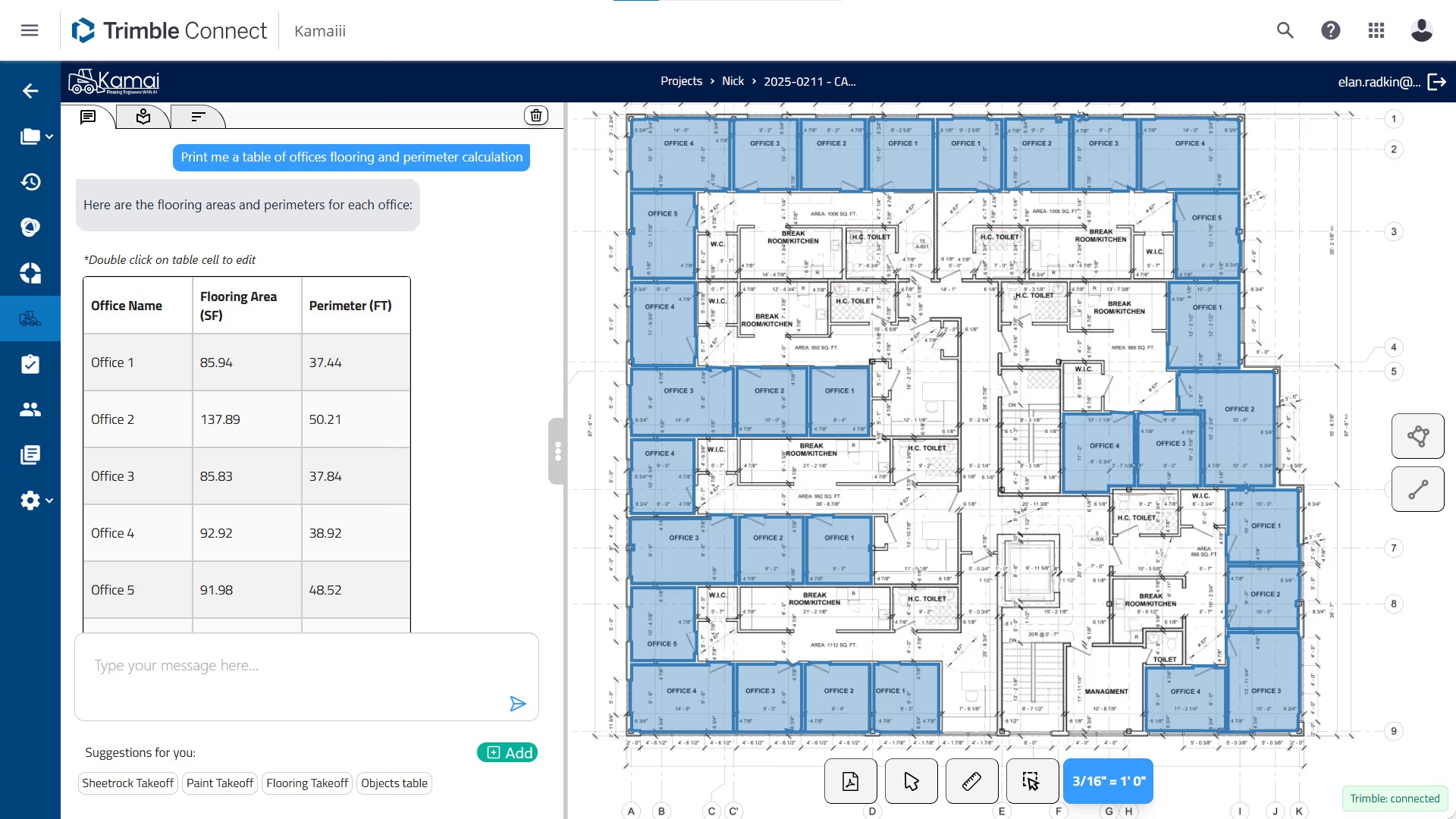
It then extracts quantities such as flooring areas, wall surfaces, and perimeter lengths for architectural components.
For MEP systems, it counts fixtures and calculates linear measurements for piping and ductwork.
All of this data is generated automatically, eliminating the need for manual measurement and calculation.
From Raw Drawings to Organized Data
After extracting quantities, Kamai organizes the data into structured formats.
Instead of scattered notes or disconnected measurements, users receive clean, categorized datasets.
These datasets can be grouped by zones, materials, or project areas, making it easier to understand and use the information.
This structured approach ensures that nothing is missed and provides a clear foundation for estimating and planning.
Processing Entire Drawing Sets, Not Just Individual Sheets
Construction projects rarely consist of a single drawing.
Kamai is designed to handle complete drawing sets, analyzing multiple sheets simultaneously.
By understanding relationships across different plans, the system provides a unified view of the project.
This eliminates the need to manually combine data from individual sheets and ensures consistency across all project phases.
Turning Data into a Queryable System
One of the most powerful aspects of extracting structured data is the ability to interact with it.
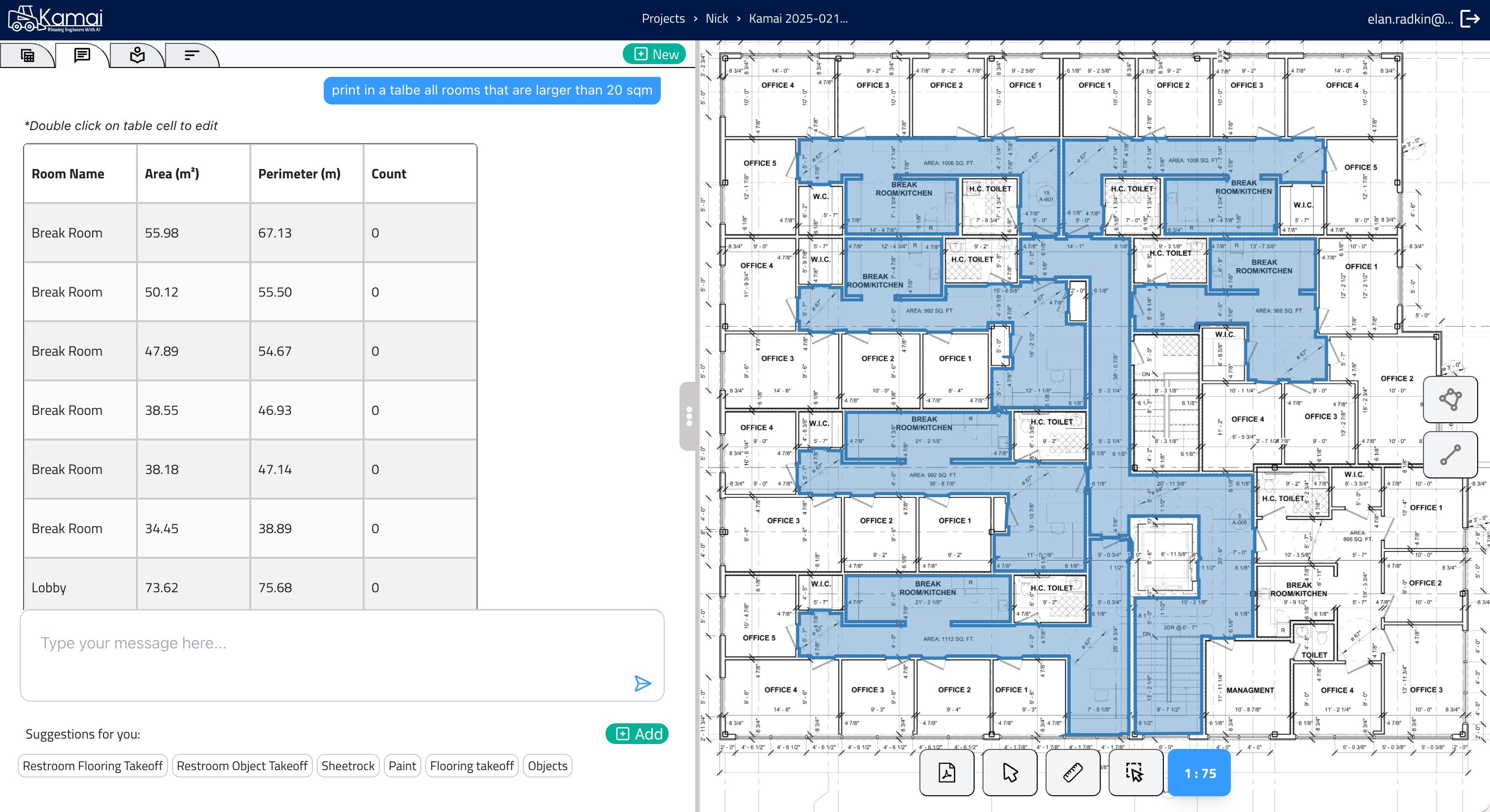
Kamai transforms PDF plans from static documents into datasets that can be queried.
Instead of manually searching through drawings or spreadsheets, users can ask questions and retrieve answers instantly.
For example, teams can identify specific room sizes, calculate total wall lengths, or summarize quantities across multiple floors.
This capability significantly reduces the time required to answer project questions and improves overall efficiency.
Reducing Errors and Improving Accuracy
Manual data extraction is one of the biggest sources of error in construction estimating.
Missed measurements, incorrect calculations, and inconsistent processes can all lead to inaccurate estimates.
Kamai eliminates these risks by automating the extraction process.
Its AI-driven approach ensures consistent results and reduces the likelihood of human error.
This leads to more reliable estimates and better project outcomes.
Supporting Faster Decision-Making
When data is structured and accessible, decision-making becomes faster and more effective.
Estimators can quickly generate accurate bids. Project managers can plan resources with confidence. Stakeholders can evaluate options based on real data.
By turning PDF plans into actionable insights, Kamai enables teams to move from analysis to action without delays.
Bridging the Gap Between Static and Dynamic Workflows
The future of construction is data-driven, but the present still relies heavily on static documents.
Kamai acts as a bridge between these two realities.
It allows teams to continue working with familiar formats like PDFs while gaining the benefits of modern technology.
This approach ensures a smooth transition to digital workflows without disrupting existing processes.
Conclusion
Extracting structured data from PDF plans is no longer a complex or time-consuming task.
With Kamai, construction teams can transform static blueprints into dynamic intelligence in seconds.
By automating quantity takeoffs, organizing data, and enabling intelligent querying, Kamai closes the gap between raw drawings and actionable insights.
In an industry where accuracy, speed, and efficiency are critical, turning PDF plans into structured data is not just an advantage it’s a necessity for staying competitive.