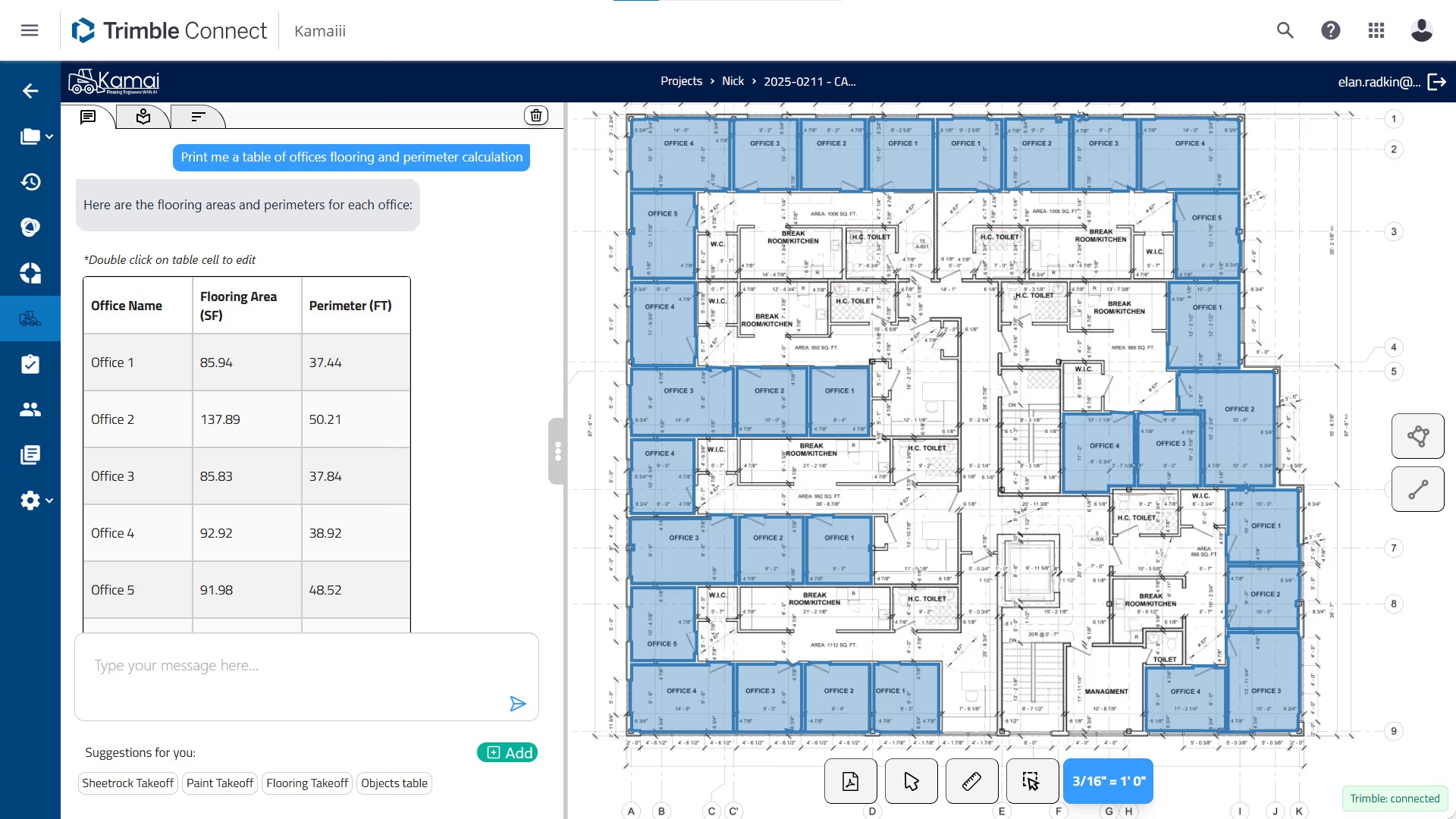
PDF Takeoff API: Converting Digital Drawings into Accurate Construction Data

March 26, 2026

Discover how Kamai’s PDF Takeoff API converts digital drawings into accurate construction data. Improve speed, accuracy, and efficiency with automated takeoff integration.
In modern construction, digital drawings have replaced paper blueprints, but the challenge of extracting accurate data from them still remains. Estimators and project teams often spend countless hours reviewing PDF plans, measuring elements, and converting visual information into usable quantities.
This is where a PDF Takeoff API becomes a game-changing solution. By integrating automated takeoff capabilities directly into your platform, tools like Kamai allow construction professionals to convert digital drawings into precise, structured data quickly, accurately, and at scale.
Understanding the Role of a PDF Takeoff API
A PDF Takeoff API is a software interface that enables applications to process construction drawings and automatically extract quantities, measurements, and material data from PDF files.
Instead of relying on manual workflows, the API allows developers and construction platforms to embed takeoff functionality directly into their systems. This means users can upload drawings, analyze them, and receive accurate data without leaving their existing environment.
Kamai’s PDF Takeoff API is designed to simplify this process by transforming complex blueprints into actionable construction insights that can be used for estimating, planning, and decision-making.
The Traditional Approach to PDF Takeoffs
Before the introduction of automated solutions, takeoffs from PDF drawings were handled manually or with limited digital tools.
Estimators would open PDF plans, zoom into sections, trace measurements, and calculate quantities using external tools like spreadsheets. While this method works, it comes with several limitations.
It is time-consuming, especially for large projects with hundreds of pages. It is also prone to human error, as even small miscalculations can lead to inaccurate estimates.
Additionally, manual workflows create inefficiencies, as data must often be re-entered into estimating systems, increasing the risk of inconsistencies.
These challenges highlight the need for a more advanced and integrated approach.
Kamai’s Approach to PDF Takeoff Automation
Kamai takes a modern, AI-driven approach to PDF takeoffs by combining automation, intelligence, and seamless integration.
Instead of treating drawings as static files, Kamai’s API analyzes them as data sources. It uses advanced algorithms to detect elements within the drawings, measure them accurately, and convert the results into structured formats.
This approach eliminates the need for manual measurement and allows teams to focus on decision-making rather than data extraction.
Kamai’s API is built to integrate easily with existing construction platforms, enabling companies to enhance their workflows without disrupting their current processes.
How the PDF Takeoff API Works
The process of using a PDF Takeoff API is designed to be simple yet powerful.
First, users upload their construction drawings in PDF format. These files can include architectural, structural, mechanical, or electrical plans.
Next, the API processes the drawings using AI and machine learning. It identifies key elements such as walls, floors, openings, and fixtures, and calculates their dimensions and quantities.
Once the analysis is complete, the system converts the extracted information into structured data. This data can include measurements, counts, areas, and volumes, depending on the project requirements.
Finally, the output is delivered in a format that can be easily integrated into estimating software, reporting tools, or project management systems.
This automated workflow significantly reduces the time and effort required to perform takeoffs.
Benefits of Using a PDF Takeoff API
One of the most significant advantages of a PDF Takeoff API is the speed it brings to the estimating process.
Manual takeoffs that once took hours or days can now be completed in minutes. This allows construction teams to respond quickly to bidding opportunities and handle more projects efficiently.
Accuracy is another major benefit. By automating measurements and calculations, the API reduces the risk of human error and ensures consistent results across all drawings.
The API also improves productivity by eliminating repetitive tasks. Estimators no longer need to spend hours measuring and counting elements, allowing them to focus on cost analysis and strategic planning.
Scalability is another key advantage. With automated takeoff capabilities, companies can process large volumes of projects without increasing their workforce.
Additionally, the integration capabilities of a PDF Takeoff API enable seamless workflows. Data can be transferred directly into estimating systems, reducing the need for manual data entry and improving overall efficiency.
Enhancing Construction Workflows with Integration
One of the defining features of a PDF Takeoff API is its ability to integrate with existing construction software.
Kamai’s API can be embedded into platforms such as estimating tools, project management systems, or custom applications. This allows users to perform takeoffs within their preferred environment.
Integration ensures that data flows smoothly between different stages of the construction process. Quantities extracted from drawings can be used immediately for cost estimation, procurement planning, and project scheduling.
This connected workflow reduces duplication of effort and ensures consistency across all project data.
Challenges in Implementing PDF Takeoff APIs
While the benefits are clear, implementing a PDF Takeoff API comes with its own set of challenges.
One of the main challenges is handling the complexity of construction drawings. Different projects use varying formats, symbols, and levels of detail, which can make data extraction more difficult.
Another challenge is ensuring accuracy across diverse project types. The API must be able to interpret drawings from different trades and disciplines without compromising precision.
Integration can also be a challenge, especially for companies with legacy systems. Ensuring that the API works seamlessly with existing workflows requires careful planning and implementation.
However, modern solutions like Kamai are designed to address these challenges through advanced AI models and flexible integration capabilities.
Overcoming Challenges with Kamai
Kamai is built to handle the complexities of real-world construction projects.
Its AI technology is trained to recognize a wide range of drawing elements, enabling it to process different types of plans with high accuracy.
The platform is also designed for easy integration, allowing developers to incorporate takeoff functionality into their systems with minimal effort.
Kamai’s focus on structured data ensures that the output is consistent, reliable, and ready for use in downstream applications.
By addressing common challenges, Kamai makes it easier for construction companies to adopt automated takeoff solutions.
Transforming Data into Better Decisions
A PDF Takeoff API does more than just automate measurements it transforms how construction teams use data.
With accurate and structured information available instantly, estimators can analyze costs, compare options, and make informed decisions more quickly.
Project managers can use this data to plan resources, manage timelines, and identify potential risks early in the process.
This data-driven approach improves overall project performance and helps companies achieve better outcomes.
The Future of PDF Takeoff Technology
As construction technology continues to evolve, PDF Takeoff APIs will become even more powerful.
Future advancements may include deeper integration with building information modeling (BIM), real-time cost forecasting, and predictive analytics.
AI will continue to improve its ability to interpret complex drawings, making automated takeoffs even more accurate and efficient.
For construction companies, adopting API-driven solutions today is a key step toward staying competitive in a rapidly changing industry.
Conclusion
The PDF Takeoff API is transforming how construction professionals extract and use data from digital drawings.
By automating the takeoff process, improving accuracy, and enabling seamless integration, solutions like Kamai are redefining construction estimating workflows.
In an industry where time, precision, and efficiency are critical, the ability to convert blueprints into accurate construction data is a powerful advantage.
For companies looking to modernize their operations and improve project outcomes, adopting a PDF Takeoff API is not just an upgrade it is a strategic necessity.