How AI Helps to Read Blueprints

March 20, 2026

Learn how Kamai uses AI to read blueprints, extract accurate data, and improve construction estimating speed, accuracy and efficiency.
Blueprints are the foundation of every construction project. They contain critical information about dimensions, materials, layouts, and specifications that guide everything from planning to execution. However, reading and interpreting these drawings has traditionally been a complex, time-consuming process that requires experience, precision, and attention to detail.
Today, artificial intelligence is transforming how construction professionals read and understand blueprints. With advanced platforms like Kamai, AI is no longer just assisting estimators it is redefining how blueprint data is interpreted, extracted, and used across the entire construction workflow.
Why Reading Blueprints Is So Challenging
Construction blueprints are highly detailed and often complex. A single project can include hundreds of pages of drawings, covering architectural, structural, electrical, and mechanical plans.
Each drawing contains symbols, annotations, measurements, and layers of information that must be interpreted correctly. Estimators and engineers must carefully analyze these elements to determine material quantities, understand project scope, and identify potential issues.
Manual blueprint reading requires significant time and expertise. Even experienced professionals can struggle with large or complex drawings, especially when working under tight deadlines.
Small errors such as missing a component or misinterpreting a scale can lead to inaccurate estimates, project delays, or increased costs.
This complexity makes blueprint interpretation one of the most critical and demanding tasks in construction.
What Does It Mean for AI to Read Blueprints?
When we say AI can “read” blueprints, we are referring to its ability to analyze and interpret visual data from construction drawings.
AI-powered systems use advanced algorithms and machine learning models to recognize patterns, symbols, and elements within blueprint files. These systems can identify objects such as walls, doors, windows, slabs, and fixtures, and then measure and quantify them automatically.
Instead of relying on manual input, AI processes the drawing data directly and converts it into structured information that can be used for estimating and planning.
Kamai leverages this technology to turn complex blueprint data into accurate, actionable insights in seconds.
From Visual Drawings to Structured Data
One of the biggest advantages of AI in blueprint reading is its ability to transform visual information into structured data.
Blueprints are inherently unstructured they contain valuable information, but it is embedded within images and symbols that are not immediately usable for calculations.
AI bridges this gap by extracting relevant data and organizing it into clear formats.
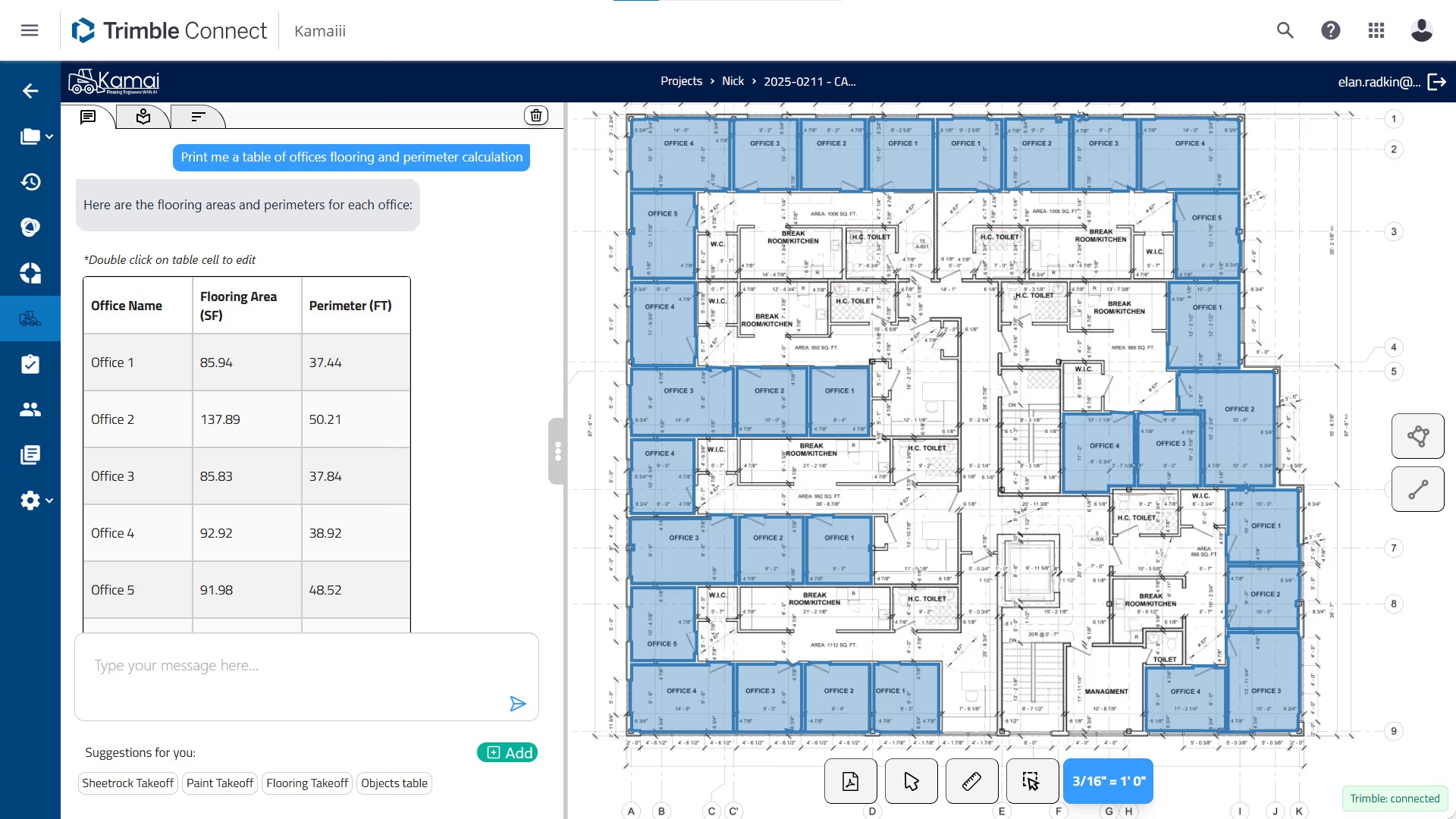
For example, instead of manually measuring each wall in a building, Kamai can automatically detect wall lengths, calculate areas, and compile the results into a structured dataset.
This structured data can then be used for estimating, reporting, and project planning, eliminating the need for manual data entry.
Speeding Up the Takeoff Process
Manual blueprint reading is one of the most time-consuming parts of the estimating process.
Estimators often spend hours reviewing drawings, measuring elements, and recording quantities. This limits productivity and slows down the bidding process.
AI dramatically accelerates this workflow.
With Kamai, users can upload blueprint files and let the system analyze them instantly. Quantities are extracted in minutes rather than hours, allowing estimators to move quickly from takeoff to cost estimation.
This speed advantage enables construction teams to handle more projects and respond faster to bidding opportunities.
Improving Accuracy and Reducing Errors
Accuracy is essential in construction estimating.
Manual blueprint reading is prone to errors, especially when dealing with complex drawings or tight deadlines. Missing a small detail or making a calculation mistake can lead to inaccurate estimates and financial losses.
AI improves accuracy by applying consistent logic to every drawing.
Kamai’s algorithms ensure that elements are detected and measured precisely, reducing the risk of missed items or incorrect calculations.
By providing reliable data, AI helps construction professionals create more accurate estimates and avoid costly mistakes during project execution.
Understanding Complex and Multi-Trade Drawings
Modern construction projects involve multiple disciplines, including architecture, structural engineering, mechanical systems, and electrical layouts.
Each discipline has its own set of drawings, symbols, and requirements.
Manually interpreting these multi-trade drawings can be overwhelming, especially for large-scale projects.
AI simplifies this process by analyzing drawings across different trades and extracting relevant data from each one.
Kamai can handle complex projects by organizing data into categories, making it easier for teams to manage and understand the full scope of work.
This capability is particularly valuable for contractors working on large commercial or infrastructure projects.
Enabling Real-Time Insights
AI does more than just read blueprints it provides real-time insights that support better decision-making.
As soon as drawings are uploaded, Kamai processes the data and delivers accurate quantities that can be used immediately.
This allows estimators to analyze project requirements, compare costs, and identify potential risks early in the process.
Real-time insights also make it easier to adapt to changes. When drawings are updated, AI can quickly reprocess the data and provide updated quantities, ensuring that estimates remain accurate.
Enhancing Collaboration Across Teams
Construction projects require collaboration between multiple stakeholders, including estimators, project managers, architects, and contractors.
AI-powered blueprint reading tools support this collaboration by providing a centralized platform for data access.
With Kamai’s cloud-based capabilities, teams can view and share blueprint data in real time. This ensures that everyone is working with the same information and reduces the risk of miscommunication.
Improved collaboration leads to better coordination, faster decision-making, and more efficient project execution.
Reducing Manual Work and Increasing Productivity
One of the biggest benefits of AI is its ability to eliminate repetitive tasks.
Manual blueprint reading involves a lot of repetitive work, such as measuring similar elements across multiple drawings or counting objects repeatedly.
AI automates these tasks, freeing up estimators to focus on more valuable activities.
Instead of spending hours on measurements, teams can concentrate on cost analysis, supplier coordination, and bid strategy.
This shift increases productivity and allows construction companies to achieve more with the same resources.
Why Kamai Is the Ideal AI Solution
Kamai is designed to bring the power of AI to blueprint reading and construction estimating.
Its advanced technology allows users to upload drawings and instantly extract accurate quantities for materials, areas, and volumes.
Kamai acts as an AI co-pilot, helping estimators interpret drawings, verify data, and make informed decisions.
By transforming blueprint data into structured insights, Kamai simplifies the estimating process and improves overall efficiency.
For construction professionals looking to modernize their workflows, Kamai offers a powerful and reliable solution.
The Future of AI in Blueprint Interpretation
The role of AI in blueprint reading is only expected to grow.
As technology advances, AI systems will become even more capable of understanding complex drawings, predicting project outcomes, and integrating with other construction tools.
Future innovations may include deeper integration with building information modeling (BIM), automated design analysis, and predictive cost forecasting.
For construction companies, adopting AI today is an important step toward staying competitive in a rapidly evolving industry.
Conclusion
Reading blueprints is one of the most critical tasks in construction, but it has traditionally been slow, complex, and prone to errors.
AI is changing this by enabling faster, more accurate, and more efficient blueprint interpretation.
With platforms like Kamai, construction professionals can turn complex drawings into structured data, gain real-time insights, and improve decision-making across projects.
In an industry where precision and speed are essential, AI-powered blueprint reading is not just an improvement it is a game-changer for modern construction workflows.