From 2D Plans to Accurate Estimates: Solving the Data Gap in Construction

Kamai.io
April 27, 2026
5 Min

Turn 2D plans into accurate estimates with Kamai. Use AI to extract quantities, speed up takeoffs, reduce errors, and solve the construction data gap faster.
Construction estimating has always depended on one thing above all else: reliable information. Before labor hours are priced, before procurement begins, and before schedules are finalized, teams need to understand exactly what must be built. Yet in many projects, the most critical source of that information is still the same as it was years ago 2D plans.
PDF drawings, scanned blueprints, consultant markups, and tender packages continue to drive real-world construction workflows. While the industry speaks often about BIM, digital twins, and connected project ecosystems, many estimators, contractors, and planners still spend their days working from static 2D documents.
This creates a serious operational challenge. Valuable project data exists inside these drawings, but it is trapped in lines, symbols, notes, and sheet sets that require manual interpretation. The result is a costly data gap between what the drawings contain and what teams need to estimate accurately.
Kamai helps solve that problem by transforming 2D plans into structured, intelligent data that powers faster, more accurate estimates and better decisions across the preconstruction process.
Why 2D Plans Still Dominate Real Construction Work
Even with growing adoption of advanced modeling tools, 2D plans remain essential for many reasons. During tender stages, fully coordinated models are often unavailable. Estimators may receive partial drawing sets, revised PDFs, or incomplete design packages under tight submission deadlines.
Many contractors also require independent quantity verification rather than relying entirely on a designer’s model. Liability concerns, scope omissions, coordination issues, or commercial risk often mean teams must validate quantities themselves.
Renovation, retrofit, and legacy asset projects create another challenge. Many existing buildings simply do not have usable models. In these cases, scanned drawings or archived plans are still the main source of truth.
This means that for many construction businesses, estimating still begins with 2D plans.
The Hidden Cost of the Construction Data Gap
A 2D drawing may contain everything needed to estimate a project, but extracting that information manually takes time and introduces risk.
Estimators often need to review multiple sheets, measure walls, calculate areas, count fixtures, compare revisions, and transfer results into spreadsheets or estimating software. This process can take hours or days depending on project size.
The hidden costs include:
- Delayed bid submissions due to slow takeoffs
- Human errors in measurements or counts
- Missed scope items buried in drawing sets
- Inconsistent outputs across team members
- Rework caused by late drawing revisions
- Reduced capacity to bid more projects
In competitive markets, these issues directly impact revenue and margin. A slow estimate can miss the deadline. An inaccurate estimate can win the job but lose the profit.
Why Accurate Estimates Start with Better Inputs
Every estimate is only as strong as the quantity data behind it. If material counts are wrong, pricing becomes unreliable. If room areas are incomplete, finishes may be underestimated. If revised sheets are overlooked, labor budgets can fail before work even begins.
That is why solving the data gap matters so much.
The goal is not simply to digitize paperwork. It is to convert static drawings into usable, structured information that estimating teams can trust.
Kamai was built specifically for this challenge.
How Kamai Turns 2D Plans into Estimating Intelligence
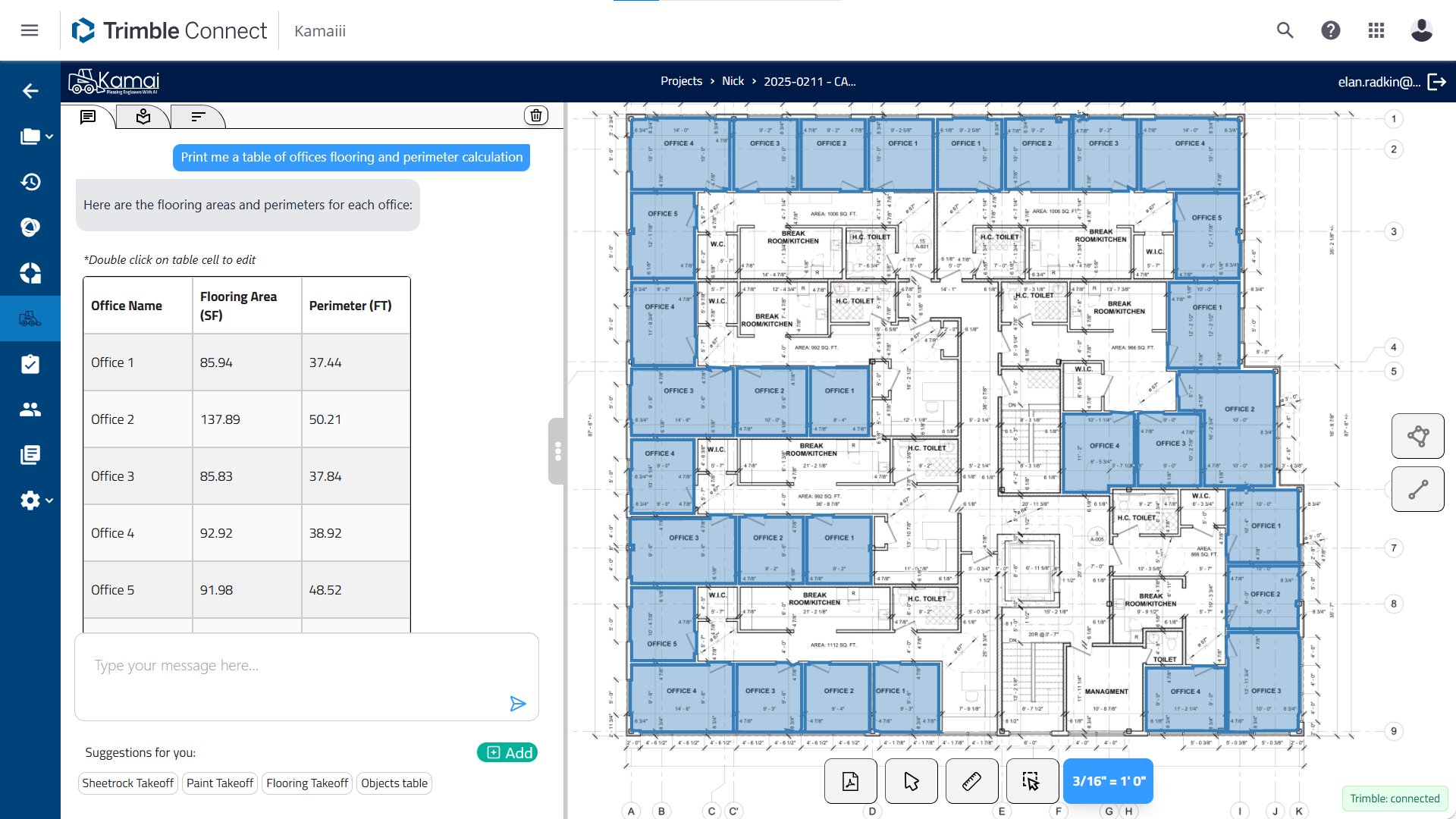
Kamai uses AI and computer vision to analyze 2D plans, PDFs, and scanned drawings. Instead of requiring users to manually trace every space or measure every wall, Kamai extracts quantities directly from uploaded plans.
The platform identifies architectural elements such as rooms, walls, openings, floor zones, and measurable surfaces. It can also recognize many relevant symbols and patterns that help estimators understand project scope faster.
Rather than treating a blueprint as a flat image, Kamai interprets it as a data source.
This enables estimating teams to move from slow manual review to rapid, structured quantity generation.
Faster Quantity Takeoffs Without Manual Bottlenecks
Traditional takeoffs often consume a major portion of the bid cycle. Skilled estimators spend valuable time on measurement tasks instead of pricing strategy, subcontractor outreach, or risk review.
Kamai reduces this bottleneck dramatically.
Users upload plan sets, and Kamai begins processing immediately. Areas, dimensions, wall lengths, room data, and quantity insights are generated quickly, allowing teams to focus on commercial decisions rather than repetitive measuring.
This creates practical benefits:
- Faster turnaround on bids
- More projects estimated with the same team
- Less overtime during deadline periods
- More time for bid review and optimization
- Greater consistency across estimates
Speed matters, but speed with accuracy is what creates a competitive advantage.
Better Accuracy Means Better Margins
Small takeoff errors often create large financial consequences. Missing a section of flooring, undercounting fixtures, or using outdated quantities can erase profit on a job.
Kamai helps improve estimating confidence by providing consistent, repeatable quantity extraction from source drawings. Instead of relying solely on manual interpretation, teams gain AI-assisted outputs that reduce common mistakes.
More accurate estimates help contractors:
- Submit stronger bids
- Protect margins
- Reduce contingency guesswork
- Improve procurement planning
- Minimize change order disputes
- Build client trust through dependable pricing
In an industry with tight margins, even modest accuracy gains can make a significant difference over time.
Handling Multi-Sheet and Complex Projects More Efficiently
Large projects rarely arrive as one simple drawing. Estimators often receive full plan packages with architecture, structural, MEP, reflected ceiling plans, revisions, and multiple floor levels.
Managing this manually is time-intensive and increases the chance of inconsistencies.
Kamai is designed to process complete drawing sets, not just isolated pages. It can identify patterns across floors, repeated layouts, zones, and project-wide quantities.
This is especially useful for:
- Apartment developments
- Hotels
- Hospitals
- Schools
- Commercial towers
- Industrial facilities
Instead of rebuilding quantities sheet by sheet, teams gain broader visibility faster.
Turning Drawings into Searchable Project Data
Another major shift in estimating is moving from reading documents to querying data.
With traditional workflows, if someone asks for total wall length on Level 2 or room counts above a certain size, an estimator may need to reopen plans and manually calculate the answer.
Kamai helps convert drawings into searchable intelligence. Teams can review structured outputs and access quantity information quickly, improving responsiveness during bids, scope reviews, and internal meetings.
This helps reduce delays and creates more agile preconstruction teams.
A Better Workflow for Modern Construction Teams
Construction businesses today face constant pressure to estimate more projects, respond faster, and maintain profitability. Yet many still rely on workflows built around static PDFs and spreadsheets.
Kamai modernizes this process without forcing teams to abandon familiar inputs. Since most projects already arrive as 2D plans, Kamai works where the industry already operates.
That means easier adoption and faster ROI.
Instead of replacing your workflow entirely, Kamai upgrades it.
Why This Matters Beyond Estimating
The benefits of solving the data gap extend beyond bid day.
Accurate quantities improve procurement planning. Cleaner scope data supports scheduling. Better documentation reduces internal confusion. Project teams begin execution with stronger assumptions and fewer surprises.
When the estimating phase improves, downstream project performance improves too.
This is why forward-thinking contractors treat estimating technology as a strategic investment, not just an admin tool.
Conclusion
2D plans remain the daily reality of construction, even in an increasingly digital world. The challenge is not the existence of drawings it is the valuable data trapped inside them.
Kamai solves the data gap by transforming static plans into accurate estimating intelligence. Through AI-powered quantity extraction, faster takeoffs, improved consistency, and better workflow efficiency, Kamai helps construction teams turn ordinary drawings into a competitive advantage.
For businesses that want faster bids, stronger margins, and smarter preconstruction decisions, the path forward begins with better data from the plans you already use.