Automating the Takeoff Process: Save Time, Boost Accuracy

March 17, 2026

Automate your construction takeoff process with Kamai to save time and boost accuracy. Discover how AI-powered takeoffs improve estimating efficiency and deliver more reliable project bids.
In the construction industry, time and accuracy are everything. Whether you are preparing a bid for a new project or planning resource allocation, the quality of your estimate directly impacts your success. At the center of every accurate estimate lies one essential process: construction takeoff.
Traditionally, takeoffs have been time-consuming and detail-heavy, requiring estimators to manually measure, count, and calculate quantities from complex drawings. While this method has been the industry standard for decades, it is no longer sufficient in a fast-moving, competitive market.
Today, automation is transforming how construction professionals approach takeoffs. With advanced solutions like Kamai, estimators can now automate the takeoff process, saving valuable time while significantly improving accuracy.
The Role of Takeoffs in Construction Estimating
Before understanding the impact of automation, it is important to recognize the role takeoffs play in construction estimating.
A takeoff involves reviewing project drawings and identifying every material required for construction. This includes measuring dimensions, calculating areas and volumes, and counting components such as fixtures, doors, and structural elements.
The data generated during the takeoff process forms the foundation of the entire estimate. Material costs, labour requirements, and project timelines all depend on the accuracy of this information.
If the takeoff is flawed, the estimate will be flawed. This can lead to underbidding, cost overruns, delays, or lost opportunities.
Because of this, takeoffs must be both precise and efficient two qualities that are difficult to achieve with manual processes alone.
The Challenges of Manual Takeoffs
Manual takeoff methods require estimators to carefully analyze drawings, often spanning hundreds of pages. Each element must be measured individually, and quantities must be recorded and organized for cost calculations.
This approach presents several challenges.
First, it is extremely time-intensive. Estimators can spend hours or even days completing takeoffs for a single project, especially when dealing with large or complex plans.
Second, manual takeoffs are prone to human error. Misreading a scale, missing a component, or making a calculation mistake can lead to inaccurate results.
Third, the process is repetitive. Estimators often perform similar measurements across multiple projects, which limits productivity and reduces efficiency.
Finally, manual workflows make it difficult to scale operations. As the number of projects increases, it becomes harder to maintain both speed and accuracy.
These challenges highlight the need for a more efficient approach to takeoffs.
What Does It Mean to Automate the Takeoff Process?
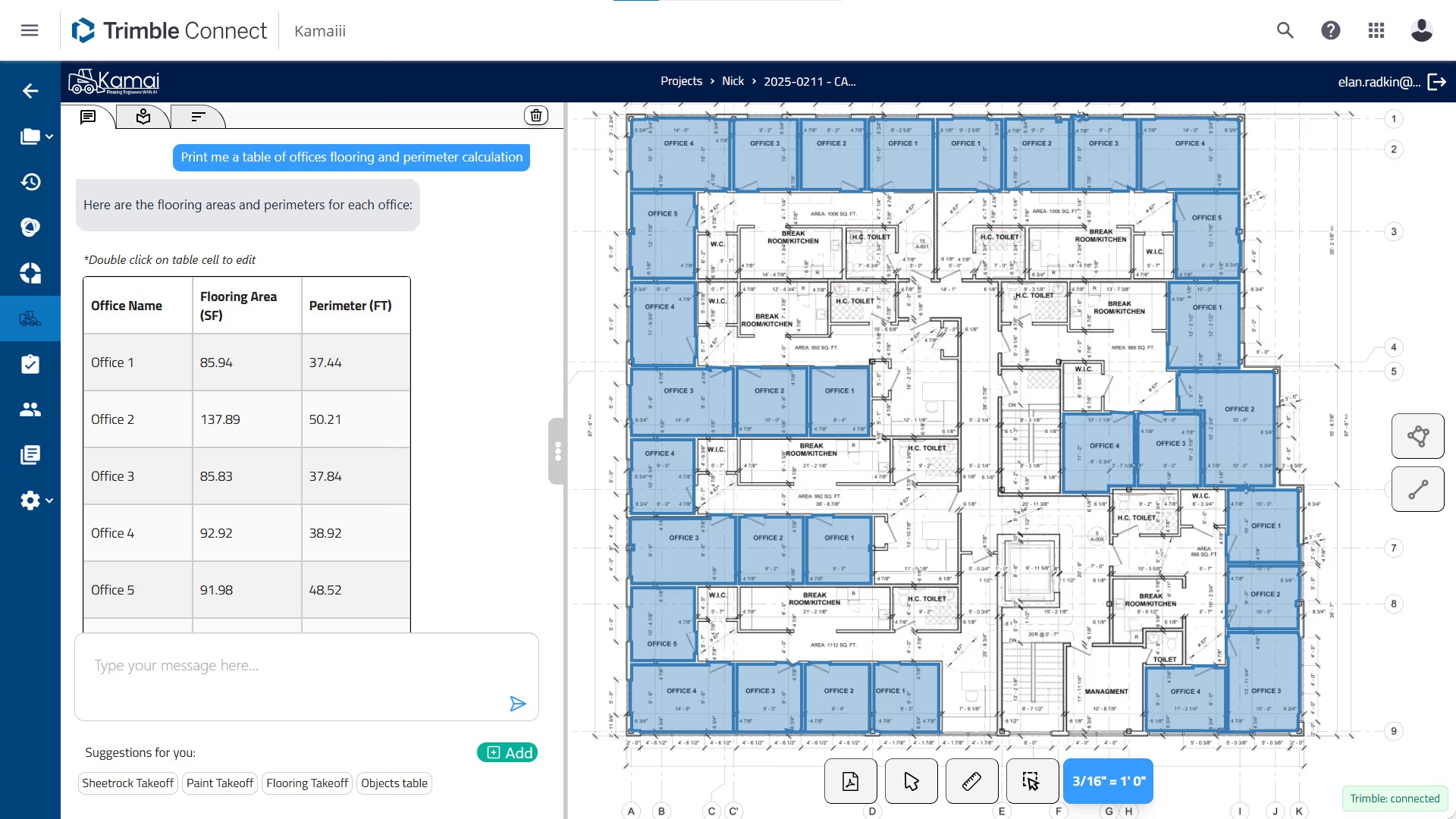
Automating the takeoff process involves using digital tools and artificial intelligence to extract quantities directly from construction drawings.
Instead of manually measuring and counting elements, automated systems analyze digital plans and identify components such as walls, floors, structural elements, and fixtures.
Modern platforms like Kamai use advanced AI technology to interpret blueprint data and convert it into structured quantity information.
This data can then be used immediately for estimating, reporting, or project planning.
Automation eliminates the need for repetitive manual tasks, allowing estimators to focus on higher-value activities such as cost analysis and bid strategy.
Saving Time Through Automation
One of the most significant benefits of automating takeoffs is the time savings it provides.
Manual takeoffs require estimators to spend hours reviewing drawings and performing calculations. Automated systems can complete these tasks in a fraction of the time.
By quickly processing large plan sets, automation allows estimators to move from takeoff to cost analysis much faster.
This efficiency has a direct impact on productivity. Estimating teams can handle more projects without increasing their workload, enabling companies to pursue more bidding opportunities.
Faster takeoffs also provide more time for reviewing estimates and refining pricing strategies, which can lead to better project outcomes.
In a competitive construction environment, speed can make a critical difference.
Boosting Accuracy and Reducing Errors
Accuracy is one of the biggest challenges in manual takeoffs.
Even experienced estimators can make mistakes when working with complex drawings or tight deadlines. These errors can lead to incorrect cost estimates and potential financial losses.
Automation addresses this issue by applying consistent measurement rules across all drawings.
AI-powered systems like Kamai can analyze plans with a high level of precision, reducing the likelihood of missed components or incorrect measurements.
By generating reliable quantity data, automated takeoff tools help estimators produce more accurate estimates and improve confidence in their bids.
Improved accuracy also reduces the risk of costly adjustments during construction, helping projects stay on budget.
Enhancing Efficiency Across Estimating Workflows
Automation does more than just speed up takeoffs it improves the overall efficiency of the estimating process.
With automated quantity extraction, data is organized and structured from the start. This eliminates the need for manual data entry and reduces the risk of inconsistencies.
Estimators can seamlessly transfer quantity data into estimating software, cost databases, or reporting tools.
This streamlined workflow reduces administrative tasks and allows teams to focus on analyzing data rather than collecting it.
As a result, estimating becomes a more efficient and strategic process.
Supporting Better Collaboration
Modern construction projects involve collaboration between multiple teams, including estimators, project managers, engineers, and contractors.
Automated takeoff solutions, especially cloud-based platforms like Kamai, make it easier for teams to work together.
Project data can be accessed and updated in real time, ensuring that all stakeholders are working with the latest information.
Changes to drawings or quantities can be reflected instantly, reducing the risk of miscommunication and improving coordination.
This collaborative approach leads to better decision-making and more successful project outcomes.
Empowering Estimators to Focus on Strategy
Automation is not about replacing estimators it is about empowering them.
By eliminating repetitive tasks such as measuring drawings and counting components, automation allows estimators to focus on more valuable aspects of their work.
Instead of spending hours on manual calculations, estimators can analyze project risks, evaluate supplier pricing, and optimize construction strategies.
This shift transforms the role of the estimator from a data processor to a strategic decision-maker.
With access to accurate and timely data, estimators can provide insights that help improve project planning and execution.
Scaling Operations With Automated Takeoffs
For construction companies aiming to grow, scalability is a major concern.
Manual takeoff processes can limit the number of projects a team can handle. As workload increases, maintaining accuracy and efficiency becomes more challenging.
Automation removes this limitation.
With tools like Kamai, companies can process more projects in less time without expanding their estimating teams.
This scalability allows businesses to take on larger projects, submit more bids, and increase revenue opportunities.
By improving both speed and accuracy, automated takeoffs create a strong foundation for growth.
Why Kamai Is Leading the Way in Takeoff Automation
Kamai is designed to help construction professionals modernize their estimating workflows through intelligent automation.
Using advanced AI technology, Kamai can analyze construction drawings and extract precise quantity data quickly and efficiently.
Its automated takeoff capabilities eliminate the need for manual measurement, reducing both time and effort.
Kamai also integrates seamlessly with existing estimating processes, making it easy for teams to adopt automation without disrupting their workflows.
By combining speed, accuracy, and ease of use, Kamai provides a powerful solution for improving takeoff efficiency and overall project performance.
The Future of Automated Takeoffs
As technology continues to evolve, automation will become an essential part of construction estimating.
Advancements in artificial intelligence and data analytics will further enhance the capabilities of takeoff tools, making them even more accurate and efficient.
Future systems may include predictive cost modeling, real-time data integration, and advanced scenario analysis.
For construction companies, adopting automation today is a key step toward staying competitive in an increasingly digital industry.
Conclusion
Automating the takeoff process is one of the most effective ways to improve efficiency and accuracy in construction estimating.
By reducing manual work, minimizing errors, and accelerating workflows, automation enables estimators to deliver better results in less time.
Solutions like Kamai are leading this transformation by providing advanced tools that convert complex drawings into reliable data.
For construction professionals looking to save time, boost accuracy, and increase profitability, automated takeoffs are no longer optional they are essential for success.