Transforming 2D Drawings into Structured Data for Better Construction Workflows

Kamai.io
April 26, 2026
5 Min
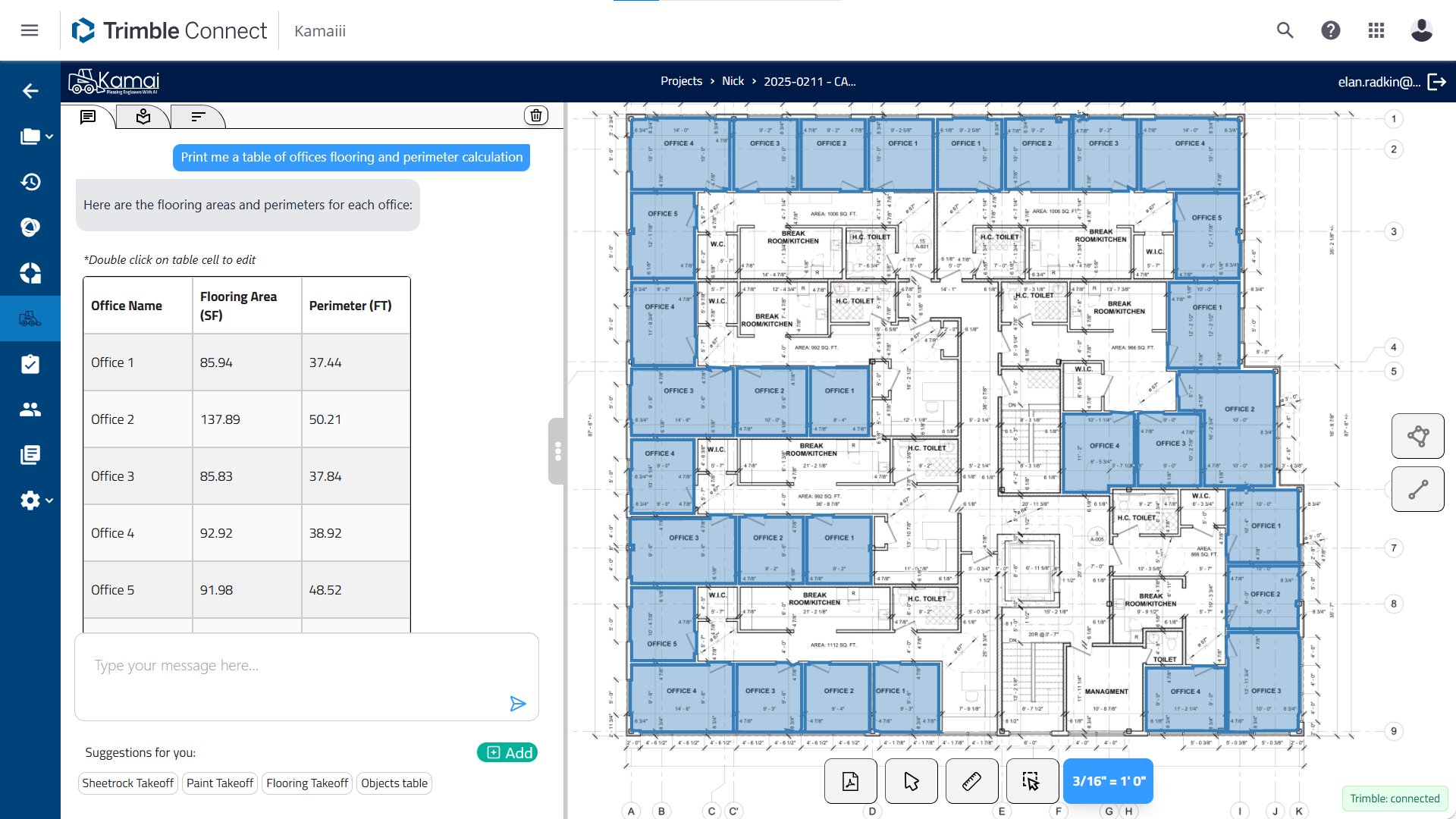
Transform 2D drawings into intelligent construction data with Kamai. Automate takeoffs, extract quantities, improve estimating accuracy, and streamline workflows faster.
The construction industry is rapidly embracing digital transformation, yet many teams still rely on one of the oldest project inputs available: 2D drawings. From PDF blueprints and scanned tender packages to consultant-issued floor plans, static documents remain central to estimating, planning, procurement, and project execution.
While advanced BIM models and digital twins receive significant attention, the everyday reality for many estimators, general contractors, quantity surveyors, and planners is different. Critical project decisions are still made from 2D plans. The challenge is that valuable data inside these drawings is often trapped in lines, symbols, annotations, and sheet sets that require manual interpretation.
This creates a costly information gap between what is available on paper and what teams need for modern decision-making.
Kamai helps solve this challenge by transforming 2D drawings into intelligent structured data that powers faster estimating, stronger workflows, and more accurate construction decisions.
Why 2D Drawings Still Dominate Construction Workflows
Despite the growth of BIM adoption, 2D documentation remains essential across many project stages. For bidding teams, consultants, subcontractors, and field planners, PDFs are still the most common source of project information.
There are several reasons for this continued reliance.
First, during tender and bid phases, complete BIM models are often unavailable. Estimators frequently receive incomplete design packages, revised PDFs, or early-stage drawings under tight deadlines. Waiting for a fully coordinated model is rarely practical.
Second, contractors often require independent quantity validation. Even when a model exists, many teams do not rely solely on the designer’s model due to liability, omissions, or coordination risks. Independent measurement and verification remain necessary.
Third, many projects involve renovations, additions, infrastructure upgrades, or legacy buildings where no usable model exists. In these situations, scanned plans and 2D documentation remain the only reliable source.
Finally, many contractual approvals, RFIs, and documentation workflows still revolve around drawings rather than model-based data.
This means that while the industry talks about future digital ecosystems, real project work still depends heavily on 2D plans.
The Hidden Cost of Static Drawings
Traditional blueprints contain valuable project intelligence, but it is buried inside visual information. Walls, openings, zones, finishes, fixtures, and dimensions must be manually interpreted and converted into measurable quantities.
This manual process creates several business problems.
Estimators spend hours reviewing sheets, measuring areas, counting symbols, and building takeoff tables. Project managers wait for quantity confirmation before making procurement or scheduling decisions. Teams struggle to keep up when revisions arrive late in the bid cycle.
Even experienced professionals can miss scope items, duplicate counts, or rely on outdated sheets. Small errors often become expensive problems later.
When drawings stay static, workflows slow down.
What construction teams need is not another PDF viewer. They need a system that turns drawings into usable data.
Turning 2D Drawings into Intelligent Data with Kamai
Kamai is designed to bridge the gap between static plans and modern construction workflows. Using advanced AI and computer vision, Kamai reads blueprint information and converts it into structured, usable outputs.
Instead of manually measuring every room or tracing every wall, users upload plan sets and allow Kamai to analyze geometry, symbols, annotations, and layouts automatically.
Kamai distinguishes between architectural elements such as walls, doors, windows, and rooms, while also identifying relevant MEP symbols and quantities. Rather than treating drawings as flat images, the platform interprets relationships between lines and shapes to understand project scope.
This transforms a passive drawing set into an active source of construction intelligence.
Faster Cost and Quantity Estimations
One of the biggest benefits of intelligent drawing analysis is speed.
Traditional quantity takeoffs can consume hours or days depending on project complexity. Large multi-sheet packages often require multiple team members to complete under deadline pressure.
Kamai dramatically accelerates this workflow.
Once drawings are uploaded, the platform begins analyzing sheets immediately. It detects dimensions, calculates measurable areas, extracts perimeter lengths, identifies materials, and organizes findings into structured outputs.
- For estimators, this means less time measuring and more time pricing.
- For contractors, it means faster bid turnaround.
- For developers, it means earlier cost visibility.
- For procurement teams, it means quicker planning based on verified quantities.
Speed is valuable, but only when paired with accuracy. Kamai delivers both.

Intelligent Quantity Takeoffs Across Disciplines
Modern projects involve more than basic area measurement. Construction teams need takeoffs across multiple scopes and systems.
Kamai supports broader quantity extraction across disciplines.
For architectural workflows, the platform can help calculate floor areas, wall surfaces, perimeter lengths, room zones, finish schedules, and space classifications.
For MEP-related planning, Kamai can assist in identifying fixture counts, outlet quantities, piping runs, duct paths, and repetitive symbols.
- For general contractors, this means faster scope validation across trades.
- For subcontractors, it means less time spent manually counting repetitive components.
- For estimators, it means cleaner data that feeds directly into pricing workflows.
Multi-Sheet Plan Set Intelligence
Many takeoff tools treat drawings one page at a time. Real projects do not work that way.
Construction documents often include dozens or hundreds of sheets covering architecture, structural, MEP, reflected ceiling plans, elevations, and revisions. Reviewing each page manually creates delays and increases inconsistency.
Kamai is built for full drawing sets.
When multiple files are uploaded, the system analyzes them collectively, identifying patterns, relationships, repeated layouts, and floor-level continuity. Instead of isolated measurements, users gain project-wide intelligence.
This is especially valuable for multi-story residential towers, hotels, healthcare facilities, schools, and commercial developments where similar layouts repeat across levels.
Rather than measuring each floor separately, teams can leverage automated recognition and summarization across the full package.
From Document Review to Conversational Querying
Perhaps one of the most transformative changes in construction workflows is moving from document reading to data interrogation.
Traditionally, if a project manager wanted to know how many wet rooms existed on Level 5 or the total interior wall length for a zone, someone had to search drawings manually or rebuild the data in spreadsheets.
Kamai changes this dynamic through intelligent querying.
Users can ask direct questions about uploaded plan sets and receive instant answers based on extracted data.
Examples include:
- Which rooms exceed a certain area threshold?
- What is the total wall perimeter on this level?
- How many fixtures appear across the building set?
- Which zones require a specific finish type?
This dramatically reduces time spent responding to RFIs, validating scope, checking quantities, or answering internal coordination questions.
The blueprint becomes searchable intelligence.
Better Decision-Making Across Construction Teams
When blueprint data becomes structured and accessible, better decisions happen faster.
- Estimators can compare options and refine pricing with confidence.
- Preconstruction teams can assess constructability earlier.
- Procurement teams can plan material purchases using cleaner quantities.
- Operations teams can prepare schedules based on real scope.
- Executives can review project exposure before bids are submitted.
Instead of waiting for fragmented manual reports, stakeholders gain direct access to measurable project insights.
This creates a stronger decision-making culture across the organization.
Eliminating Manual Measurement Bottlenecks
Manual takeoffs are one of the most common bottlenecks in preconstruction. They consume valuable technical labor that could be used for higher-value work such as bid strategy, vendor negotiation, scope review, or value engineering.
Kamai helps eliminate this bottleneck.
By automatically extracting dimensions and quantities, teams no longer depend on rulers, scale tools, repeated tracing, or spreadsheet re-entry. Professionals can redirect time toward decisions that improve win rates and profitability.
The result is not simply faster estimating. It is smarter resource allocation.
Improving Accuracy and Reducing Risk
Every inaccurate estimate creates risk.
Under-counted materials can erode margin. Overestimated quantities can reduce competitiveness. Missed scope items can lead to change orders, disputes, or schedule pressure.
Kamai reduces these risks by providing consistent, data-driven quantity extraction from source drawings.
Because outputs are structured and repeatable, teams gain better control over assumptions, revisions, and documentation. This is especially valuable in competitive bid environments where small pricing differences determine who wins the project.
Why Kamai Matters Now
Construction margins remain tight. Deadlines are shorter. Labor is harder to find. Bid volume expectations continue to rise.
At the same time, many teams still rely on workflows built around static PDFs and manual measurement.
Kamai helps modernize these workflows without forcing organizations to abandon the formats they already use. Instead of replacing 2D plans, Kamai upgrades them into intelligent project data.
That makes adoption practical, immediate, and valuable.
The Future of Construction Workflows Starts with Better Inputs
The industry often focuses on downstream technology such as project controls, scheduling dashboards, or digital twins. But those systems are only as strong as the data entering them.
If project inputs begin with manual measurement and spreadsheet re-entry, inefficiency is built into the process from the start.
Kamai improves construction workflows at the source by transforming 2D drawings into structured intelligence from day one.
That means faster estimates, cleaner quantities, stronger planning, and smarter decisions throughout the project lifecycle.
Conclusion
2D drawings are not disappearing anytime soon. They remain central to bidding, planning, validation, and execution across the construction industry. The real opportunity is not to ignore them, but to unlock their hidden value.
Kamai transforms static blueprints into intelligent data that supports better construction workflows. By automating takeoffs, extracting quantities, analyzing drawings instantly, and enabling faster decisions, Kamai helps teams move from document dependency to data-driven execution.
For construction companies that want more speed, better accuracy, and stronger margins, the future starts with turning 2D plans into intelligence.